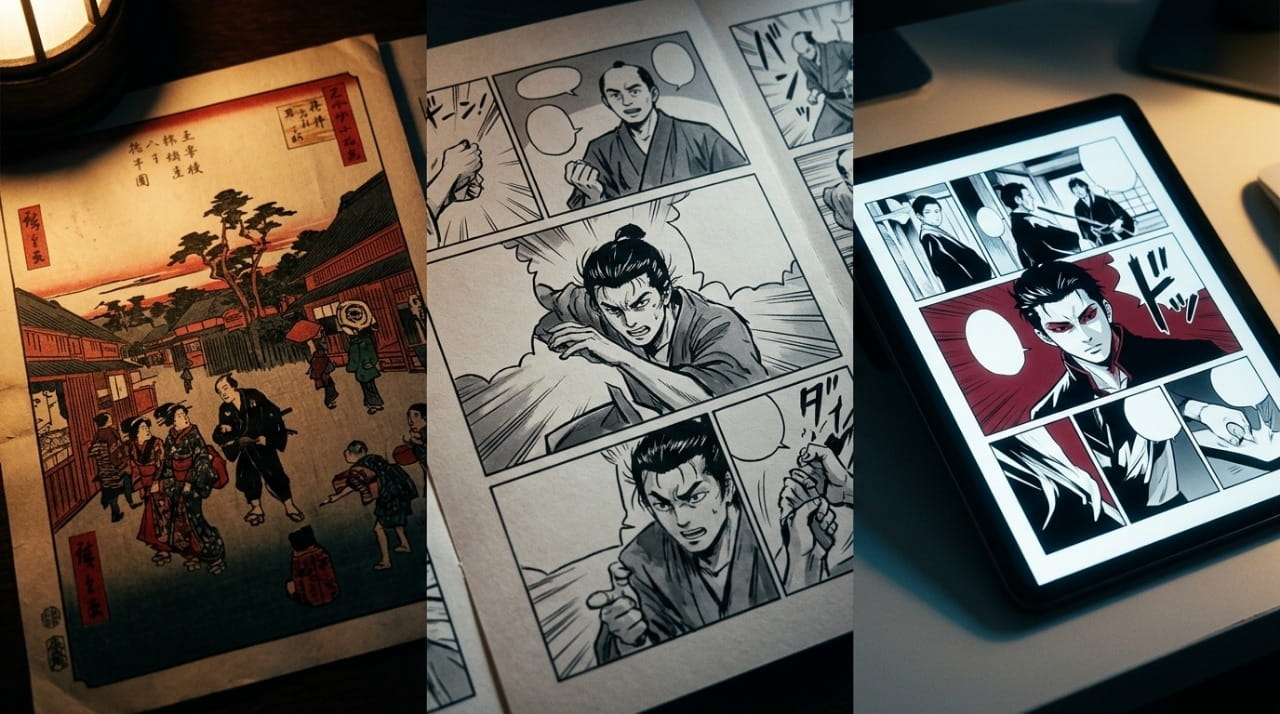
Manga is now the most recognizable face of Japanese popular culture. From bookstore shelves to digital platforms, from school playgrounds to museums, the Japanese comic has established itself as a global cultural phenomenon worth billions and shaping the imagination of entire generations. But behind One Piece, Naruto, or Dragon Ball lies a history far longer than one might imagine: nearly a thousand years of graphic evolution, from the painted scrolls of Buddhist temples to the webtoons scrolled through on smartphones.
In this comprehensive guide, we retrace the thread of the history of manga: its ancient origins, the birth of the word itself under Hokusai's brush, the revolution of Osamu Tezuka, the golden age of the great magazines, and then the conquest of the entire world. Whether you are a collector, a passionate reader, or simply curious, you will finally understand how this art form became a true global industry.
The answer in brief: manga has its roots in 12th-century Japanese painted scrolls and Edo-period woodblock prints; the word was popularized by Hokusai in 1814, the modern form was born with Osamu Tezuka in 1947, and global conquest took place through anime in the 1980s-1990s — with France becoming the second-largest manga market in the world.
Key takeaways
- 12th century: the Chōjū-giga, satirical scrolls considered the oldest ancestor of manga
- 1814: Hokusai publishes his "Hokusai Manga" sketchbooks and popularizes the word
- 1947: Osamu Tezuka revolutionizes Japanese comics with New Treasure Island
- 1968: launch of Weekly Shōnen Jump — the golden age of magazines begins
- Today: France is the 2nd largest global market for manga, and One Piece is the best-selling manga in history (over 500 million copies)
Table of Contents
- 1. The origins: from painted scrolls to Edo prints
- 2. Hokusai and the birth of the word "manga"
- 3. The Meiji era: caricature and Western influence
- 4. The interwar period and the first paper heroes
- 5. Osamu Tezuka, the "god of manga"
- 6. The golden age of magazines
- 7. Global conquest
- 8. The digital era and manga today
- 9. Understanding the major genres of manga
- Summary table
- Frequently asked questions
1. The origins: from painted scrolls to Edo prints
To find the roots of manga, one must look long before the invention of modern printing. As early as the 12th century, during the Heian and Kamakura periods, Japanese monks and artists created emaki (絵巻), long paper scrolls combining painting and text, which were unrolled horizontally to follow a narrative. This is exactly the principle of sequential storytelling through images — the very DNA of comics.
The emaki, distant ancestors of Japanese comics
The most famous of these scrolls is the Chōjū-giga ("Animal Caricatures"), a set of four scrolls attributed to the monk Toba Sōjō, dating from the 12th and 13th centuries. They depict frogs, rabbits, and monkeys behaving like humans: fighting, praying, and mocking the nobles and clergy of the time. This satirical, lively, and humorous style is why the Chōjū-giga is often considered the oldest ancestor of manga. It already reflects the Japanese taste for caricature, movement, and mockery.
Ukiyo-e prints and the popular culture of Edo

During the Edo period (1603-1868), Japan experienced a long period of peace and saw the birth of a flourishing urban culture. This was the golden age of ukiyo-e, woodblock prints depicting the "floating world": kabuki actors, landscapes, scenes of daily life, and legendary heroes. Mass-producible and affordable, the prints became a form of mass entertainment accessible to the common people. This popular dissemination of printed images paved the cultural ground upon which modern manga would later flourish.
Kibyōshi, the first popular illustrated books
Even closer to modern manga, the kibyōshi ("yellow covers") appeared at the end of the 18th century. These small, cheap illustrated books combined text and drawings on the same page to tell satirical, comedic, or fantastic stories intended for an adult audience. With their sequential narration and biting humor, they are often considered the first true Japanese "comic books," nearly a century before the appearance of manga as we know it.
2. Hokusai and the birth of the word "manga"
While the word "manga" is world-famous today, we owe it in large part to one of the greatest artists in Japanese history: Katsushika Hokusai (1760-1849), the creator of the famous Great Wave off Kanagawa.
Who was Hokusai?
An undisputed master of ukiyo-e, Hokusai was a draftsman of legendary productivity. Starting in 1814, he published a series of sketchbooks titled "Hokusai Manga": thousands of drawings depicting everything that came under his brush — common people, animals, plants, fantastic creatures, poses, and facial expressions. These collections, designed as models for artists, met with immense success and helped popularize the term.
What does the word "manga" really mean?
The word manga (漫画) is composed of two characters: man (漫), which evokes what is "free, spontaneous, done at whim," and ga (画), which means "image" or "drawing." One could therefore translate it as "drawings executed freely" or "images drawn at the whim of the mind." Contrary to a widespread idea, Hokusai did not invent the term — it already existed among other authors like Santō Kyōden — but he was the one who brought it to prominence. The modern meaning, designating comics, would not prevail, however, until the 20th century.
3. The Meiji era: caricature and Western influence
The Meiji era (1868-1912) marked a brutal turning point: after more than two centuries of closure, Japan opened up to the world and modernized at a forced march. Along with Western techniques, ideas, and goods came a new graphic language: press caricature.
The arrival of European caricature
Two foreigners played a decisive role. The Briton Charles Wirgman founded The Japan Punch in 1862, a satirical magazine that introduced the codes of European press cartooning. The Frenchman Georges Bigot, who lived in Japan in the 1880s, bitingly sketched a Japanese society in the midst of Westernization. These artists passed on to Japanese cartoonists the use of speech bubbles, panel sequences, and a sense of political satire.
Kitazawa Rakuten, the first professional mangaka
It is in this context that Kitazawa Rakuten (1876-1955) emerged, often considered the first professional manga artist in the modern sense. He founded the magazine Tokyo Puck in 1905 and popularized the use of the word "manga" to describe his humorous comics. The bridge was now established between the Japanese graphic tradition and modern comics.
4. The interwar period and the first paper heroes
In the 1920s and 1930s, manga was structured around a specific audience: children. The youth press developed with magazines like Shōnen Club, which published serialized stories, month after month.
Norakuro and the first popular series
The big star of this era was Norakuro, a clumsy dog soldier created by Tagawa Suihō in 1931. His adventures met with phenomenal success and demonstrated that a serialized comic could retain a readership over time — a business model that would become the norm. This period durably established the habit of serialized publication, where each chapter kept the reader in suspense until the next issue.
Kamishibai, the street paper theater
At the same time, kamishibai, or "paper theater," spread: traveling storytellers would ride their bicycles through neighborhoods, telling stories by scrolling through large illustrated boards, attracting children to whom they sold treats. Very popular during the 1930s to the 1950s, this medium would train many future manga artists and nurture their sense of suspense and cliffhangers.
The interlude of the war
World War II brought this boom to a sudden halt. Paper became scarce, military censorship imposed its themes, and many cartoonists were put to work for propaganda. It would take the defeat of 1945 and the subsequent reconstruction for manga to be reborn — and then undergo its greatest revolution.
5. Osamu Tezuka, the "god of manga"

If only one name were to be remembered in the entire history of manga, it would be Osamu Tezuka (1928-1989). Nicknamed the "god of manga" (manga no kamisama), this doctor by training deeply redefined what a comic could be.
A revolution from cinema
In 1947, the young Tezuka published Shin Takarajima (New Treasure Island), an album that had the impact of a bomb. Instead of aligning static panels, he borrowed from cinema: close-ups, high-angle shots, tracking shots, and dynamic layouts that gave an impression of movement and emotion. A great admirer of Walt Disney and American cartoons, he gave his characters large, expressive eyes, which have since become a visual signature of manga.
Astro and the invention of "story manga"
Tezuka created ambitious and profound works, starting with Astro Boy (Tetsuwan Atom, 1952), the story of a little robot endowed with a heart, but also Kimba the White Lion or Princess Knight, which laid the foundations for girls' manga (shōjo). He established the "story manga": long serialized narratives featuring real story arcs, complex characters, and adult themes such as death, war, and the human condition. Comics were no longer just simple childish entertainment: they became a true medium for authors.
Tokiwa-sō, the cradle of a generation of geniuses
Tezuka's influence goes beyond his work. In the early 1950s, he lived in a modest apartment building in Tokyo, Tokiwa-sō, which became a true breeding ground for talent. Young artists who came to admire him settled there and forged their craft: the duo Fujiko Fujio (future creators of Doraemon), Shōtarō Ishinomori (Cyborg 009), and even Fujio Akatsuka, the master of comedy manga. A whole sector of modern manga was born in this small, now legendary building.
6. The golden age of magazines

The years from 1960 to 1980 constituted the golden age of manga. The industry was organized around a central object: the prepublication magazine, those thick, inexpensive weekly publications where chapters of dozens of series appeared every week.
The reign of the major weeklies
1959 saw the publication of the first issues of Weekly Shōnen Magazine and Weekly Shōnen Sunday. But it was the Weekly Shōnen Jump, launched in 1968, that would become the most influential title in the history of manga. Its operation was ruthless: readers voted every week for their favorite series, and the least popular ones were mercilessly canceled. This editorial Darwinism pushed authors to outdo themselves and brought out the greatest hits of the following decades.
Segmentation by audience: shōnen, shōjo, seinen
This era saw the market finely segmented according to the readership: shōnen for boys, shōjo for girls, then seinen for young adults. In shōjo, the famous "Year 24 Group" (female authors born around 1949) revolutionized the genre with works like The Rose of Versailles by Riyoko Ikeda (1972).
The economic secret: the tankōbon
The magazine was in reality only a showcase. Printed on recycled paper and sold at or near a loss, it served to test series with the public. The real profit came from tankōbon, those bound volumes that compiled chapters of a successful series. Sold in bookstores and treasured by readers, they formed the heart of the manga business model — a system still in effect today.
Gekiga, a darker manga
In parallel, as early as 1957, the artist Yoshihiro Tatsumi coined the term gekiga ("dramatic images") to describe a realistic, dark, and adult manga, aimed at an audience that had grown up with Tezuka. The medium thus gained thematic maturity and stylistic diversity.
7. Global conquest

Starting in the 1980s, manga spilled over Japan's borders. The engine of this expansion? Its alliance with animation: animated series (anime) derived from hit manga crossed the oceans and created a tremendous momentum.
Anime, the locomotive of manga
Works like Akira by Katsuhiro Otomo (manga in 1982, animated film in 1988) revealed the maturity and ambition of Japanese comics to the Western world. At the same time, series like Dragon Ball by Akira Toriyama (1984), Saint Seiya, or Sailor Moon became intergenerational phenomena.
Arrival in France, the second home of manga
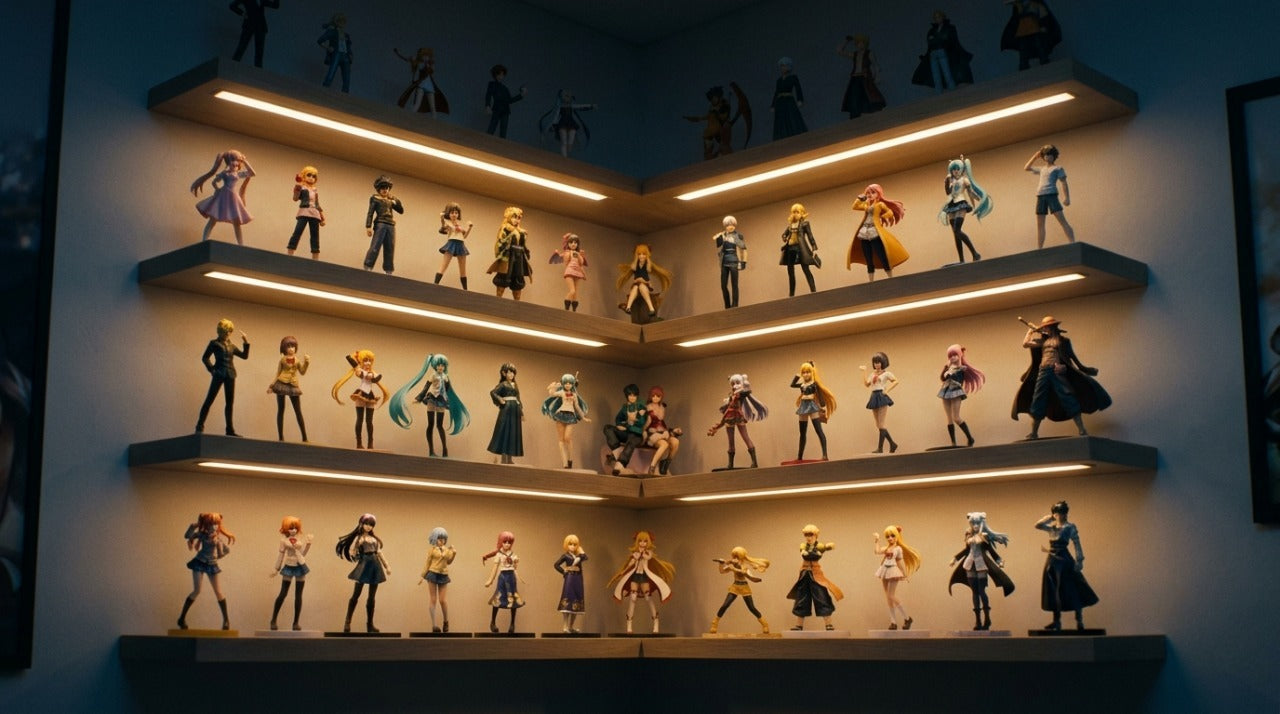
France occupies a special place in this history. As early as 1978, the giant robot Goldorak (Grendizer) caused a real cultural shock on French television. Then, from 1987 to 1997, the show Club Dorothée broadcast hundreds of anime episodes and shaped an entire generation. On the publishing side, Akira was published by Glénat in 1990, paving the way. Even today, France is the second-largest manga market in the world, just behind Japan. A passion that we cultivate daily in our manga figure collection.
From the United States to the whole world
America followed the same path. Hayao Miyazaki's Studio Ghibli helped promote Japanese animation as an art form, while the Pokémon phenomenon, at the end of the 1990s, threw open the doors to the global market. Publishers like Viz Media gradually imposed the original Japanese format, keeping the right-to-left reading direction — a bold choice that eventually became the norm and testifies to the growing respect for the original work.
8. The digital era and manga today

The turn of the 21st century again upended the way manga is created, distributed, and read. The Internet and the smartphone changed everything.
From scantrad to official simulpub
In the early 2000s, fan communities illegally translated and distributed scanned chapters (scantrad), revealing an immense global appetite. The industry reacted by offering simulpub: the official and simultaneous digital publication of chapters worldwide, the very day they were released in Japan.
Webtoons, the new revolution
Hailing from South Korea, webtoons are imposing a new format designed for smartphones: vertical, full-color reading that you scroll through with your thumb. Platforms like Webtoon or Piccoma reach hundreds of millions of readers and attract an audience that is often younger and more female-dominated.
An undeniable success
Far from killing off print, digital has broadened the audience. Manga now represents an overwhelming share of the publishing market in Japan and is setting sales records all over the world. Eiichirō Oda’s One Piece series holds the record for the best-selling manga in history, with over 500 million copies sold. This enthusiasm extends even to everyday items, from figurines to manga phone cases.
A new global golden age
The 2020s mark a peak. The Demon Slayer phenomenon is breaking all records, with its animated film becoming one of the biggest successes in the Japanese box office. During the pandemic, manga sales exploded in the West, particularly in the United States, where the medium is experiencing spectacular growth. Driven by streaming platforms like Crunchyroll and Netflix, which broadcast anime worldwide on the day of their release, manga has never been more powerful. What was once a Japanese curiosity has become a pillar of global culture.
9. Understanding the major manga genres

Contrary to a common misconception, "manga" does not refer to a genre but to a medium. Within this medium, works are traditionally classified according to the intended audience:
- Shōnen: aimed at adolescent boys, it highlights action, friendship, and personal growth (the world of Dragon Ball, Naruto, or One Piece).
- Shōjo: aimed at teenage girls, it favors relationships, emotions, and romance, with an often delicate graphic style.
- Seinen: for young adults, more mature and realistic, it addresses complex themes (Berserk, Vagabond).
- Josei: for an adult female readership, centered on nuanced life stories.
- Kodomo: designed for young children, with simple and kind-hearted stories.
This segmentation explains the incredible richness of manga: there is a work for every age, every sensibility, and every interest.
Summary table of manga history
| Period | Key stage | Work / prominent figure |
|---|---|---|
| 12th-13th century | Narrative scrolls (emaki) | Chōjū-giga (animal caricatures) |
| 1603-1868 (Edo) | Popular prints | Ukiyo-e |
| 1814 | Popularization of the word "manga" | Hokusai Manga |
| 1868-1912 (Meiji) | Press caricature | Kitazawa Rakuten, Tokyo Puck |
| 1931 | Children's series | Norakuro |
| 1947-1952 | "Story manga" revolution | Osamu Tezuka, Astro |
| 1968 | Golden age of magazines | Weekly Shōnen Jump |
| 1980-2000 | Global conquest via anime | Akira, Dragon Ball, Goldorak |
| 2000-present | Digital and webtoons | One Piece, online platforms |
To go further: the Kyoto International Manga Museum houses over 300,000 pieces, and the BnF has digitized Japanese prints available online.
Frequently asked questions about the history of manga
What is the difference between a manga and an anime?
Manga refers to the paper (or digital) comic book, while anime refers to its animated cartoon adaptation. Many anime are based on successful manga, but the two remain distinct media.
Does manga really come from Japan?
Yes. While modern caricature was influenced by Europe during the Meiji era, manga draws its deep roots from the Japanese graphic tradition, from the emaki scrolls of the 12th century to ukiyo-e prints.
Why are manga read from right to left?
Because Japanese is traditionally written and read from right to left. Western publishers chose to maintain this original reading direction to respect the work and its composition.
What is the best-selling manga of all time?
It is Eiichirō Oda's One Piece, with over 500 million copies sold worldwide, an absolute publishing record.
Who is considered the father of modern manga?
Osamu Tezuka, nicknamed the "god of manga." His cinematic approach and long-form auteur stories defined manga as we know it today.
What was the first manga to exist?
It depends on the definition. The Chōjū-jinbutsu-giga scrolls (12th century) are the ancestor most often cited; the word itself was born with the Hokusai Manga in 1814; the first modern narrative in panels with a recurring character is generally attributed to Kitazawa Rakuten at the very beginning of the 20th century; and the manga as we read it today began in 1947 with Osamu Tezuka's New Treasure Island.
Why is manga in black and white?
For an economic reason that has become an aesthetic one: pre-publication magazines appear every week, with hundreds of pages on cheap paper — color would be unaffordable and too slow to produce. Authors therefore built a language of screens, speed lines, and contrasts that is self-sufficient. Only a few opening pages are in color.
What are the 3 types of manga?
The three main categories, defined by the intended audience rather than the genre: shōnen (teenagers), shōjo (teenage girls), and seinen (young adults). Josei (adult women) and kodomo (children) are often added. A shōnen can be a thriller and a seinen a comedy: the category describes the reader, not the story.
And if this history makes you want to dive into the greatest manga journey, follow our guide to all One Piece arcs and sagas in order.
From paper to your collection
From Hokusai to Tezuka, from Edo prints to smartphone screens, manga has never stopped reinventing itself while remaining faithful to its essence: telling great stories through images. And this passion doesn't stop at reading — it continues in collecting. Bringing a figurine of your favorite character into your home means possessing a fragment of this thousand-year-old history.
👉 Discover our selection of collectible manga figurines and bring your favorite heroes to life.