A collection of manga figurines is much more than just a row of objects on a shelf: it is months of searching, patience, and passion combined in a few centimeters of PVC. And yet, three silent enemies threaten every piece the moment it comes out of the box: sunlight, dust, and humidity. A poorly displayed figurine can fade in just a few months, while the same piece, properly protected, remains as good as new for decades.
In this comprehensive guide, we review everything you need to know to display and maintain your manga figurines: choosing between an open shelf and a closed display case, creating an exhibition corner worthy of the name, adopting the right cleaning routine, and avoiding the mistakes that ruin a collection. Whether you own three figurines or three hundred, these tips apply today.
In short: to keep your manga figurines looking brand new, display them away from direct sunlight, ideally in a closed display case or on an LED-lit shelf, dust them every one to two weeks with a soft-bristled brush, and clean them two to three times a year with a slightly damp microfiber cloth. Never use alcohol, solvents, or abrasive sponges on PVC.
Key takeaways
- Never in direct sunlight: UV rays irreversibly fade and yellow PVC.
- A closed display case is the best protection: it eliminates 90% of the dusting work.
- LEDs are the ideal lighting: they emit almost no UV or heat.
- Dusting every 1 to 2 weeks with a soft brush, damp cleaning 2 to 3 times a year.
- Forbidden products: alcohol, acetone, bleach, abrasive sponges, hot water.
- Always keep the boxes: essential for moving, storage, or resale.
Table of contents
- 1. The three enemies of your figurines
- 2. The open wall shelf: the accessible solution
- 3. The closed display case: the ultimate protection
- 4. Creating a dedicated display corner with LED lighting
- 5. Shelf, display case, or dedicated corner: a comparison
- 6. The 5-step cleaning routine
- 7. Mistakes and products to avoid at all costs
- 8. Boxes and long-term storage
- 9. Maintenance summary calendar
- Frequently Asked Questions
1. The three enemies of your figurines
The three main causes of degradation for a manga figurine are direct sunlight, dust accumulation, and temperature/humidity fluctuations. The good news: all three are easily neutralized, provided you know about them.
Sunlight and UV: enemy number one

Ultraviolet rays attack paint pigments and the plastic itself. A figurine exposed to direct sunlight behind a window can start to fade within months: reds turn to pink, blues wash out, and whites yellow. The worst part? This discoloration is irreversible—no amount of cleaning will bring back the original colors. The golden rule is simple: no figurine should ever receive direct sunlight, not even for a few hours a day. Move your shelves away from south and west-facing windows, or install filtering curtains.
Dust: slow but persistent

On an open shelf, a thin layer of dust settles within one to two weeks. Beyond the dull appearance it gives the colors, dust becomes problematic when it settles: mixed with ambient humidity, it forms an oily veil that sticks to the PVC and clings to the crevices of the sculpture—hair strands, clothing folds, textured bases. The longer you wait, the more delicate cleaning becomes.
Heat and humidity: the discreet duo
PVC begins to deform at surprisingly low temperatures: a figurine placed near a radiator, a gaming console that gets hot, or in a car during summer can see its thin parts (swords, hair, capes) slowly bend under their own weight. Humidity, in turn, promotes mold on boxes and a sticky film on the plastic. Aim for a normal living space: 18 to 24°C (64 to 75°F), humidity between 40 and 60%, and above all, stable conditions. Avoid kitchens, bathrooms, and garages.
2. The open wall shelf: the accessible solution

A wall shelf is the simplest and cheapest way to display manga figurines: just a few dozen euros are enough to showcase an entire collection. It is the ideal choice for beginners, provided a few rules are followed. It is also, by far, the gift missing from almost every collection: we mention this in our manga gift ideas by person and budget guide.
Positioning your shelf correctly
Fix it to a wall that never receives direct sunlight, at eye level to appreciate the sculptural details. Avoid placing it above a radiator or a warm TV stand. Leave space between each piece: a figurine needs to "breathe" visually, and you will prevent the domino effect when reaching for one of them.
Staging your collection
Organize by universe rather than by size: a One Piece shelf, a Dragon Ball shelf, a Naruto shelf—each tells a story. Place large pieces at the ends and smaller formats in the center, slightly elevated if necessary. Figurines that interact—two rivals, a legendary duo—are best displayed facing each other.
Watch out for the weight of large formats
A large-format collector's figurine can weigh several kilos, base included—a piece 40 cm or larger, such as a 42cm Goku Ultra Instinct figurine, deserves a reinforced shelf, fixed with wall plugs adapted to the wall type (drywall, brick, or concrete). Check the maximum load indicated by the manufacturer: a shelf that sags will eventually fail.
3. The closed display case: the ultimate protection

A closed display case is the best possible protection for a figurine collection: it blocks dust, spills, bumps, pets, and curious little hands. It is the investment to make as soon as your collection gains value—either financial or sentimental.
Glass or plexiglass?
Glass offers perfect transparency and is scratch-resistant, but it is heavy and fragile. Plexiglass (acrylic) is light and shatterproof, but scratches more easily during cleaning. For a large floor-standing display case, tempered glass is the safe bet; for wall-mounted cubes or individual displays, acrylic works perfectly.
Integrated lighting changes everything
An illuminated display case transforms a collection into a true museum exhibition: integrated LED spotlights highlight paint gradients and the transparency effects of the pieces. Choose a warm white (2700-3000K) for a cozy atmosphere, or a neutral white (4000K) for faithful colors.
The right reflex: spacing out rows
The temptation is great to fill every shelf to capacity. Resist: foreground figurines hide those in the back, and every bit of handling becomes risky. Small formats, like a 10cm Luffy Gear 5 figurine, fit perfectly on risers or display steps that add depth to the case.
4. Creating a dedicated display corner with LED lighting

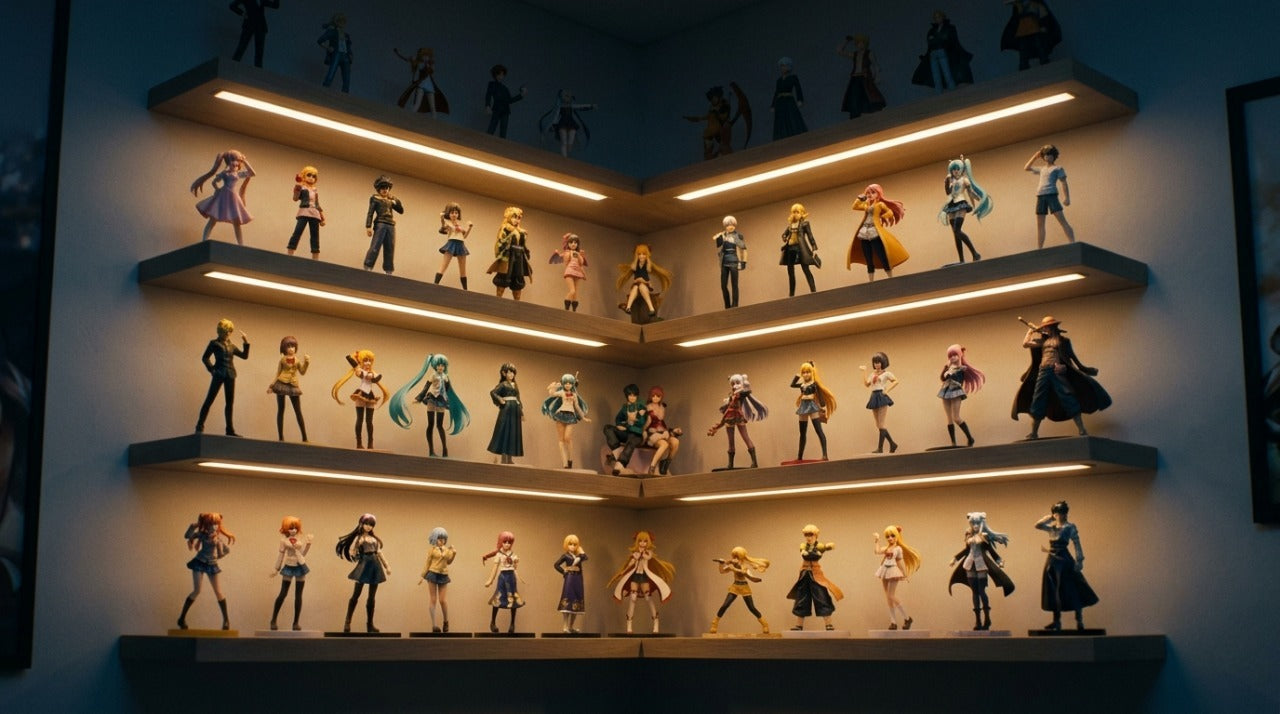
A dedicated display corner—often above a desk or gaming setup—has become the signature of collectors: an entire section of wall devoted to figurines, posters, and ambient lighting. It is the solution that best highlights a collection on a daily basis.
Why LEDs are your allies
Unlike halogen bulbs or sunlight, LED strips and spotlights emit almost no UV rays and very little heat: you can light your figurines for several hours a day without the risk of discoloration or deformation. An LED strip stuck under each shelf creates a "museum display" effect for just a few euros, and RGB models allow you to match the ambiance to your favorite universe.
Composing the perfect wall
Vary shelf heights to accommodate both large and small formats, frame the collection with posters or Japanese wall scrolls, and maintain color consistency between the lighting and decoration. A dark wall background (midnight blue, charcoal) makes the vibrant colors of the figurines stand out much better than a white wall. And if you want to extend the universe into your pocket, a matching manga phone case completes the look.
5. Shelf, display case, or dedicated corner: a comparison
| Criteria | Open shelf | Closed display case | Dedicated corner + LEDs |
|---|---|---|---|
| Budget | € (€20-60) | €€€ (€100-400) | €€ (€50-150) |
| Dust protection | Low | Excellent | Low to medium |
| Dusting frequency | Every 1-2 weeks | 2-3 times a year | Every 1-2 weeks |
| Visual appeal | Good | Excellent (integrated lighting) | Spectacular |
| Ideal for | Beginners, small collections | Valuable pieces, large collections | Gaming setups, dedicated rooms |
In practice, many collectors combine all three: centerpiece items in a display case, daily figurines on LED shelves, and the whole arrangement organized into a dedicated corner that evolves with the collection.
6. The 5-step cleaning routine
Cleaning a manga figurine takes less than five minutes when done regularly. Here is the complete method, from routine maintenance to deep cleaning.
Step 1: dry dusting, the basics

Every one to two weeks, use a soft-bristled brush (a clean makeup brush or a hobbyist dust brush) over the entire figurine, paying attention to the nooks and crannies: hair strands, folds, base. An air blower or a can of compressed air (used at a distance, in short bursts) dislodges dust from inaccessible areas. This simple action prevents 90% of difficult cleaning tasks.
Step 2: damp cleaning, 2 to 3 times a year

When dust has become ingrained or a dull film appears, switch to damp cleaning: use a barely damp microfiber cloth, dipped in lukewarm water with a drop of mild soap (Marseille soap or very diluted dish soap), then wrung out well. Clean with light touches, without scrubbing hard or soaking the figurine.
Step 3: rinse and air dry
Pass a clean, damp cloth over the figurine to remove soap residue, then pat it with a dry cloth and leave it to air dry, away from any heat source—never use a hair dryer or radiator, as they can deform the PVC.
Step 4: inspect while cleaning
Cleaning is the perfect time to check the status of your collection: a part that is coming loose, a joint that has become loose, or early signs of yellowing are spotted early and are easily treated. Also check the stability of the base and tighten connections if necessary.
Step 5: put back… in the right place
Take the opportunity to re-evaluate the location: has the sun shifted with the season? Has a new heat source appeared? A well-cleaned figurine put back in the wrong place is back to square one.
7. Mistakes and products to avoid at all costs

Most damaged figurines are not ruined by time, but by overly aggressive cleaning. Here is the blacklist:
- Alcohol, acetone, solvents: they directly attack the paint and can make PVC sticky or whitish.
- Bleach and aggressive household products: discoloration guaranteed, sometimes in a single application.
- Abrasive sponges and scrapers: irreversible micro-scratches on shiny surfaces.
- Hot water or prolonged immersion: PVC softens and deforms; stickers and glued parts peel off.
- Drying in the sun or with a hair dryer: heat + UV, the losing combo.
- Handling with greasy fingers: sebum leaves traces that trap dust—wash your hands before handling your pieces, or hold them by the base.
If in doubt about a product, test it first under the base, in an invisible area. And if a figurine has become sticky over the years (a common phenomenon related to PVC plasticizers), a simple wash with lukewarm soapy water is usually enough to restore its original feel.
8. Boxes and long-term storage

Should you keep the boxes for your figurines? Yes, always. The original box protects the figurine during moves, allows for safe storage when you rotate your collection, and significantly increases the resale value of a piece. A figurine with its box in good condition resells much better than the same piece alone.
Storing boxes correctly
Store them flat or upright in a dry cupboard, away from light, without placing anything heavy on top. Keep the blisters and plastic inserts inside: they are what keep the figurine in place during future transport.
Storing a figurine long-term
To put part of your collection away, place each figurine back in its original blister, in a closed box, in a temperate, dry room—never in an overheated attic or a damp basement. Add a silica gel packet to the storage carton to absorb residual moisture, and avoid stacking more than three or four boxes so as not to crush the ones at the bottom.
9. Maintenance summary calendar
| Action | Frequency | Tool |
|---|---|---|
| Dry dusting | Every 1-2 weeks (open shelf) | Soft brush, air blower |
| Dusting in closed case | 2-3 times a year | Soft brush |
| Damp cleaning | 2-3 times a year, or if dull film appears | Microfibre + warm soapy water |
| Full inspection (wobble, yellowing, base) | With every wet cleaning | — |
| Display check (sun, heat) | At each change of season | — |
| Cleaning the display case (glass) | Once a month | Microfiber (glass cleaner on the cloth, never directly) |
Frequently asked questions about manga figure care
How often should a manga figure be dusted?
Every one to two weeks on an open shelf, using a soft-bristled brush. In a closed display case, dusting two to three times a year is enough — this is one of the great advantages of a display case.
How do I clean a figure that has become sticky?
The sticky feel comes from plasticizers migrating to the surface of the PVC over time. A gentle wash in warm water with a drop of soap, followed by a rinse and air drying, is usually enough to restore a normal feel.
Do LEDs damage figures?
No. Unlike the sun or halogen bulbs, LEDs emit almost no UV radiation and very little heat. This is the recommended lighting for showcasing a collection without the risk of fading.
Can you fix a figure that has yellowed from the sun?
Unfortunately, no: UV-induced discoloration is an irreversible chemical alteration of the paint and plastic. This is why prevention—avoiding direct sunlight at all costs—is the number one rule for collectors.
Should I keep my figure boxes?
Yes, always. The box protects the figure during transport and storage periods, and an item resold with its original box in good condition significantly increases in value on the second-hand market.
What temperature and humidity are right for a collection?
A standard living area is perfect: 18 to 24°C (64-75°F) and 40 to 60% humidity, with stable conditions. Avoid rooms with extreme fluctuations like kitchens, bathrooms, attics, or garages.
How should I display figures?
At eye level or just below, on a shelf with a neutral background or in a closed display case, away from direct sunlight and heat sources, using indirect LED lighting. Space out the items so each one can be appreciated, layer by height (larger ones in the back), and dust with a soft brush every two to three weeks. Specific details for each material can be found in the guide.
How can I make my figures stand out?
Three key factors: light (a warm LED strip at the top of the shelf, never a direct spotlight), depth (a dark or textured background brings out colors), and height (bases and risers so the items in the back don't disappear). Our article on figure staging shows the set we use for all our photos.
How do I display tiny figures?
On risers or tiered display stands, in a shallow glass case, or a cabinet with close-set shelves: none should be hidden by another, and dust must not be allowed to accumulate. Chibi and miniature figures also look better when grouped by series. See our display stands and cabinets for figures.
Do figures increase in value?
Some do, but not the majority. Limited editions, discontinued items from highly sought-after licenses, and figures in mint condition with their box can be resold for more than their original price; mass-produced PVC figures generally do not. The rule is simple: buy what you want to display, keep the box, and consider any increase in value a bonus.
A collection that stands the test of time
Properly displaying and maintaining your manga figures requires neither expensive equipment nor special skills: a spot away from the sun, a soft brush every two weeks, and a little method are enough to keep each piece looking like it did on day one. Your collection tells your story as a fan—it deserves these five minutes of attention. And if you want to understand where this passion that drives us all comes from, dive into our article on the history of manga, 1000 years of evolution.
Want to see how far you can take your staging? Behind the scenes of our Manga Horizon photo studio shows how the shop's images are born.
And for wall mounting without drilling, our display stands and shelves for figures do the trick.
👉 Have an empty spot on your shelf? Explore our manga figure collection and find your next centerpiece.
And because a shelf isn't just for the eyes: our Attack on Titan music box plays Call of Silence via a hand crank, no batteries or speakers needed—one more object to place between two figures, with atmosphere as a bonus.