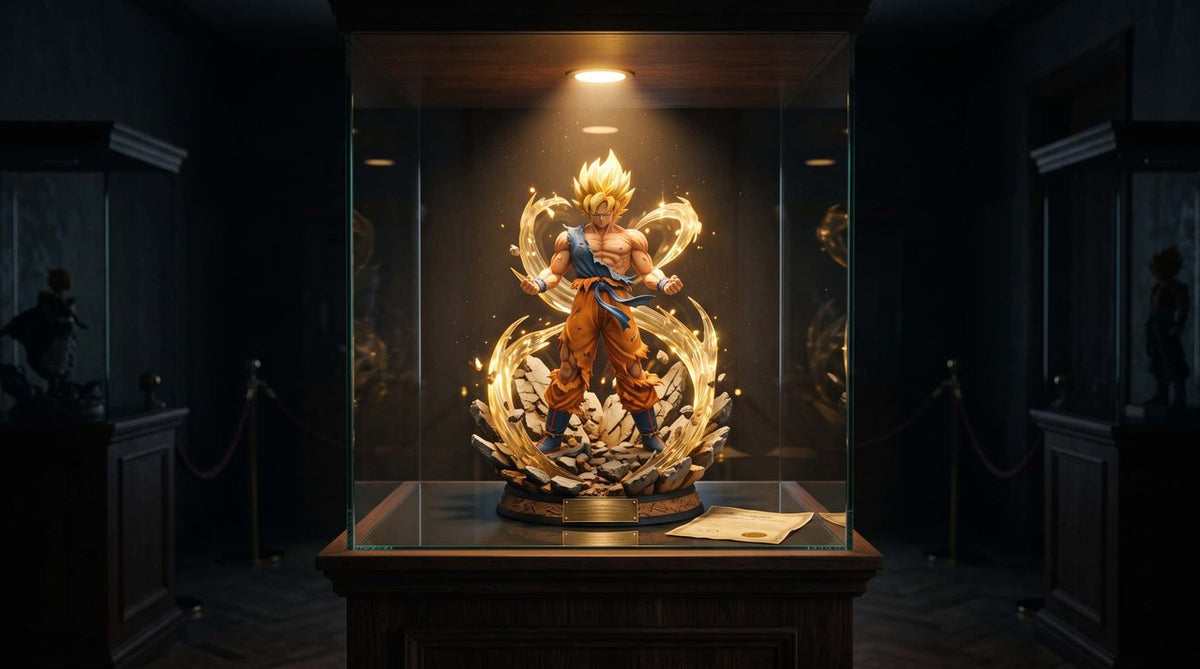
A Dragon Ball figure can cost €25 or €2,600. The difference between the two is not just size: it could be a numbered edition of 500, a Japanese lottery, an exclusive convention item, or a Bandai box sealed since 1996. This article explores the highly sought-after pieces by collectors, detailing for each what it is, its original launch price, and why it's so rare, with figures sourced from the manufacturer's website or specialized press. And because nobody has €1,400 to spend on a Broly, each mythical piece is followed by what you can place on your shelf instead from our catalog, without breaking the bank.
The Essentials in Brief
- The most expensive Dragon Ball figure offered by a manufacturer is Tsume's Bardock Ultra HQS: €2,241.67 excluding taxes at launch, or approximately €2,620 all taxes included, for an edition of 500 copies — and already on a waiting list even before its delivery, scheduled for late 2026.
- The top tier is dominated by Tsume resin statues: from €349 for Piccolo and Gohan to €1,460 for a 90 cm 1/4 scale Goku, all sold out.
- Rarity stems from four mechanisms: limited and numbered editions, event exclusivity, the Ichiban Kuji lottery with its limited prizes (often 100 copies), and age — 1996 Bandai figures that are still sealed.
- Rare does not mean better: a 1996 Bandai figure in its box is worth several hundred euros because there are so few left, not because it is better sculpted than a contemporary piece.
- For every mythical piece, there is a PVC figure of the same character, often in the same scene, at a fraction of the price. This is the second half of this article.
Table of Contents
- Why a Dragon Ball Figure Becomes Rare
- How to Interpret the Prices in This Article
- 1. Bardock Ultra HQS: 500 Copies, €2,620
- 2. Son Goku 1/4: 90 cm and Two Interchangeable Bodies
- 3. Legendary Broly: The Resin That Drove Up Prices
- 4. Frieza Final Form HQS+: 76 cm of Tyrant
- 5. Super Saiyan 3 Gotenks: 800 Copies and Seven Ghosts
- 6. Goku Kaio-ken and Vegeta Galick Gun: The Duel in Two Statues
- 7. Piccolo and Gohan, Goku vs. Nappa: "Entry-Level" Resins, Already Untraceable
- 8. Convention and Lottery Exclusives: Golden Shenron, King Cold, Angel Goku
- 9. The 1996 Bandai Figures: When the Box Is Worth More Than the Figure
- 10. The Giant PVCs: 45 cm for $265
- Resin or PVC: What You're Really Paying For
- The Kiosk Collection: 50 Issues and 2 Special Editions
- The Secondhand Market: Where and How
- What to Buy Instead: The Character-by-Character Table
- Starting a Dragon Ball Collection Without Breaking the Bank
- Maintaining a Piece's Value
- Frequently Asked Questions
- For More Information
Why a Dragon Ball Figure Becomes Rare
Dragon Ball is the most produced franchise in the history of Japanese figures. Since the first Bandai series in the late 80s, there hasn't been a year without a new wave of Goku figures. And yet, some pieces are impossible to find. Four mechanisms explain this, and they often combine.

The first is limited and numbered editions. The resin statues from Tsume, a studio located in Luxembourg, are produced in a pre-announced number of copies — 500 for the Bardock Ultra HQS, 800 for Gotenks, 4,000 for Frieza — each with a numbered plaque and a certificate. Once an edition is sold out, there are no reissues: the manufacturer's page changes to "Sold out" and remains so.
The second is event exclusivity. Japan has a tradition of figures distributed only at conventions, in specific retail chains, or to moviegoers at special screenings. They never go through conventional sales: anyone who wasn't there on that day will only be able to acquire them secondhand.
The third is the lottery. Banpresto's Ichiban Kuji sells tickets, not figures; the grand prize exists only in a few tens or hundreds of copies for all of Japan and has never had a retail price. We will come back to this below.
The fourth is simply age. A 1996 Bandai figure is not exceptional in terms of sculpting, but thirty years later, those that have remained in their sealed boxes are few — and it's the box, not the figure, that you're paying for.
How to Interpret the Prices in This Article
All prices cited are launch prices obtained from manufacturers on September 3, 2026: Tsume's website for resin figures, specialized press for Japanese exclusives and vintage pieces. Tsume's website displays prices excluding taxes to unregistered users; we provide both the displayed amount and its equivalent with all taxes included, calculated at the Luxembourg rate and rounded. Dollar prices are those announced by the retailer.
We do not publish any specific resale values from sellers: these change weekly and depend on the condition and packaging. When an auction result has been made public, we cite it with its source and date. When a piece sells for more than its launch price, we mention it; the exact amount is for you to verify on the day of purchase.
1. Bardock Ultra HQS: 500 Copies, €2,620
The most expensive Dragon Ball piece ever offered by Tsume is not a Goku. It's his father. The Bardock Ultra HQS, at 1/4 scale, is listed at €2,241.67 excluding taxes on the manufacturer's website, or approximately €2,620 all taxes included, for an edition of 500 copies worldwide. The statue is 70 cm tall and just as wide, with integrated LED lighting, and its delivery is announced between the third and fourth quarter of 2026. As of writing, it is already on a waiting list: the entire edition sold out before the first piece reached a buyer.
"Ultra HQS" is the pinnacle of the studio's range: a large-scale statue, a base that tells a scene, and material and lighting effects. Choosing Bardock, a character who appears only in a TV special and a few flashbacks, says something about the target audience — collectors who know the series by heart and for whom the death of Goku's father, facing Frieza alone, is a foundational scene.
Instead: Bardock is not in our catalog, and we don't pretend he is. But father and son share the same Saiyan warrior silhouette, and the son dominates the display case: Goku Super Saiyan 3 in 35 cm, or, for sheer scale, Goku in his fire tornado, 46 cm — the largest piece in our selection.
2. Son Goku 1/4: 90 cm and Two Interchangeable Bodies
The Son Goku SSJ1 at 1/4 scale is the tallest statue in Tsume's Dragon Ball range: 90 cm with its base, 57 cm wide, made of resin, PVC, and metal, with sequence-controlled LED lighting. It was offered at €1,249.17 excluding taxes — approximately €1,460 all taxes included — for an edition of 1,400 copies, delivered between late 2024 and late 2025. The unique feature that earned its reputation: it comes with two interchangeable bodies, Goku as a Saiyan and Goku as a Super Saiyan, with an additional base to display the second. Two statues in one, essentially. The page displays "Sold out" and a waiting list.
The moment depicted is the first transformation on Namek: hair standing on end, golden aura, cold anger. It's the scene everyone knows, and that's also why the edition sold out — a Dragon Ball collector who buys only one statue in their life buys this one.
Instead: the same first transformation, in PVC: Goku Super Saiyan with LED base and two heads, which reprises the idea of dual expression; or Goku Super Saiyan with explosive aura, for the version where energy overflows.
3. Legendary Broly: The Resin That Drove Up Prices
Tsume's Broly - Legendary Super Saiyan is a 1/4 scale, 76 cm statue, made of resin and PVC, released in the third quarter of 2019 at €853.85 excluding taxes — €999 all taxes included — for 1,500 copies. It also exists in a "King of Destruction" edition, same edition of 1,500, at €1,195.73 excluding taxes, or almost €1,400: this version adds an alternative bust of Broly preparing an energy ball, whose LED lights illuminate both the attack and the character's eyes. Both versions have been sold out for a long time.
Broly is the most popular movie villain in the franchise, by far. The Legendary Super Saiyan from the 90s received three films, then a complete rewrite in 2018 that brought him into the series' canon. Each new release rekindles demand for existing pieces, and this 2019 resin arrived at exactly the right time — a year after the movie that put the character back in the spotlight.
Instead: Legendary Super Saiyan Broly in 20 cm, the 90s version, including musculature and green hair; or for the scene from the 2018 movie, the Broly vs. Gogeta diorama, with both adversaries on a single base.
4. Frieza Final Form HQS+: 76 cm of Tyrant
The Frieza 4th Form HQS+ — Frieza in his final form, from Namek — is a 76 cm statue made of resin, PVC, and magnets, with LED, offered at €1,111.11 excluding taxes, or €1,300 all taxes included. Its edition is the largest on this list, 4,000 copies, delivered between late 2022 and late 2023; and yet the page displays "Sold out." This is proof that a large edition doesn't protect against anything when the character is the manga's most famous villain.
What's striking about this piece is its simplicity: Frieza is small, smooth, white, and purple, and the statue derives its presence from the height of the base and the lighting rather than a spectacular pose. The exact opposite of Saiyans in a full energy explosion — and this is the contrast collectors seek to balance a display case.
Instead: the same final form in PVC, Frieza Final Form in 27 cm, or the Namek confrontation in a single piece with the Goku vs. Frieza diorama. For extravagance, our Golden Frieza at 48 cm is the tallest piece of the character we offer.
5. Super Saiyan 3 Gotenks: 800 Copies and Seven Ghosts
The Gotenks Super Saiyan 3 HQS Dioramax has the shortest production run in Tsume's Dragon Ball range after Bardock: 800 copies, priced at €1,040.83 excluding taxes — approximately €1,220 all taxes included — for a 1/6 scale, 54 cm statue made of resin and metal, delivered between late 2025 and spring 2026. The scene is the Kamikaze Ghost Attack: Gotenks surrounded by seven ghosts, each with its own expression, in an electrical atmosphere rendered by an LED sequence. Sold out.
This is an audacious subject choice. Gotenks, the fusion of the two children, is as much a comedic character as he is a fighter, and the grimacing ghosts are the kind of detail a manufacturer usually simplifies. Here, they are the subject. A collector who wants a unique piece for their shelf will go for this one — and the 800-copy edition indicates Tsume knew this.
Instead: exactly the same scene, in PVC and shelf-friendly size: Gotenks Super Saiyan with his ghost, 24 cm; or the compact version, Gotenks in 10 cm.
6. Goku Kaio-ken and Vegeta Galick Gun: The Duel in Two Statues
Tsume sculpted the first encounter between Goku and Vegeta on Earth into two 1/6 scale statues designed to face each other. The Goku Kaio-ken, 37 cm, at €597.44 excluding taxes — €699 all taxes included — and the Vegeta Galick Gun, 61 cm in standard version and 73 cm with the complete diorama, at €725.64 excluding taxes, or €849. Each was produced in 3,000 copies, delivered in the first half of 2022, each with interchangeable arms allowing the energy sphere to be placed or removed from the character's hands, translucent resin auras replaceable with rocks, and an LED base. Both pages display "Sold out."

The diptych logic explains the value: a collector who owns one wants the other, and the set is rarely resold separately. In the series, this is the battle that shifts Dragon Ball from an adventure story to a power-driven narrative — the Kaio-ken multiplied by three against the Galick Gun, two beams meeting in the middle of the screen. The two statues precisely replicate that moment.
Instead: for Vegeta, Majin Vegeta Unleashed in 28 cm or the Namek duel with Vegeta vs. Guldo; for Goku during the same era, Goku and the Spirit Bomb in 25 cm, the attack that followed the Kaio-ken in the same fight.
7. Piccolo and Gohan, Goku vs. Nappa: "Entry-Level" Resins, Already Untraceable
Tsume's first two Dragon Ball resins were the most accessible, and today they are the hardest to find. Piccolo's Redemption — Piccolo sacrificing himself to protect Gohan from Nappa's attack — was offered in late 2016 at €298.29 excluding taxes, or €349, for 2,500 copies, 34.7 cm tall. The Quiet Wrath of Son Goku — Goku breaking Nappa with a Kaio-ken blow — was released in the second half of 2018 at €341.03 excluding taxes, €399, for 4,000 copies, 43.7 cm. Both have been sold out for years.
These pieces depict the same saga, the Saiyans, and the two scenes occur minutes apart in the anime. That's why they are sought after together. And it's a useful reminder: rarity doesn't depend on the initial price. A €349 resin with an edition of 2,500 becomes harder to find than a €1,300 piece with an edition of 4,000, simply because more people could afford it on preorder day.
Instead: the exact scene of the second statue, in PVC: Goku lifting Nappa, 19 cm. For Piccolo and Gohan, Piccolo in 17 cm and Gohan Super Saiyan 2 at the Cell Games, the moment the student surpassed the master.
8. Convention and Lottery Exclusives: Golden Shenron, King Cold, Angel Goku
Here, we move away from European manufacturers to the Japanese tradition of figures that cannot be bought in stores. The FROM JAPAN shopping service compiled a list in 2015 that remains the reference, and the pieces it cites have not been reissued since.

Banpresto's gold and silver Shenron, approximately 30 cm, distributed by the Ichiban Kuji lottery in one hundred copies of each color. The 33 cm King Cold offered at the Tokyo Toy Festival 2008, limited to 500 pieces. The angel Goku, halo included, a monthly Ichiban Kuji prize in 100 copies. The Vegeta great ape diorama by ZEEM studio, 30 cm, released at the Super Festival in 2009 in 300 pieces worldwide — and its color variations of fifty, twenty, and ten. And, at the top of the list, a Goku in Yardrat attire distributed to moviegoers in Japan, the number of which is unknown.
The principle of Ichiban Kuji deserves an explanation, because it inherently creates rarity. You buy a ticket, between 500 and 1,200 yen depending on the lottery, and you draw a prize ranked from A to G. Prizes A and B are large figures; lower-tier prizes are glasses, towels, or keychains. The "Last One" goes to the person who draws the last ticket from the box: there is only one per box, and it has never had a price. It is the only figure in the world whose value is calculated by the number of lost tickets.
Alternatively: for Shenron, Shenron the Sacred Dragon, or Goku Super Saiyan and Shenron, the invocation on a single base. For Frieza's family, in lieu of King Cold, Metal Cooler in 29 cm, the machine-rebuilt brother.
9. 1996 Bandai figures: when the box is worth more than the figure
Bandai figures from the 90s are nothing like today's statues: fifteen centimeters, a twist articulation, simple paint. What makes them expensive is time. According to the specialized website Jouets Vintage, which reported in April 2026, the 1996 Super Saiyan Goku was produced as a limited edition of 5,000 copies, and a collection of twelve sealed Bandai Dragon Ball Z figures sold for €8,500 on Catawiki in 2025. The same source notes that the color variant — a blue tunic instead of orange — fetches even higher prices, and that an intact twist mechanism adds to the value.

Here, the logic is different from that of resins: there's no manufacturer counting copies, there are boxes that have survived thirty years in attics and with children. The rule is simple and brutal — a figure out of its box loses two-thirds of its value, regardless of its condition. A vintage collector doesn't buy a figure, they buy a sealed box.
Alternatively: the same Super Saiyan Goku, thirty years of sculpting later and barely more expensive than in 1996: Goku Super Saiyan sitting in 11 cm, or Goku Super Saiyan 2 in chubby version for a shelf of small pieces.
10. Giant PVC figures: 45 cm for $265
Not all large pieces are made of resin. Japanese manufacturer X-Plus, known for its Godzillas, released a 45 cm Ultra Instinct Goku in PVC in its "Gigantic" series, announced at $265 for pre-order at American retailer BigBadToyStore. The print run is not numbered, but the series operates in waves: once a wave is sold out, the item disappears from shelves, and the Super Saiyan Blue Gogeta from the same series was sold in Japan as a limited exclusive for 13,000 yen.
This is an interesting case because it sits exactly between the two worlds of this article: the format of a statue, the material of a figure. And it's proof that you can have 45 cm of Goku on a shelf without resorting to resin or four-figure prices.
Alternatively: the same form, in the same spirit: Goku Ultra Instinct in 42 cm, three centimeters from the Gigantic; or the compact version with its translucent aura, Goku Ultra Instinct in 25 cm.
Resin or PVC: what you're really paying for
All the four-figure pieces in this article are made of resin, all alternatives are made of PVC. The difference is not a matter of paint quality — it's in the process. Resin is cold-poured into flexible molds, piece by piece, and hand-painted: this allows for large scales, fine details, and short runs, and it's also what makes it expensive. PVC is hot-injected into steel molds, by the thousands: the mold is expensive, each piece is cheap, and the material is more flexible, thus less brittle.
Concretely, a resin is heavier, more fragile, and more detailed; a PVC is lighter, more robust, and more affordable. A 76 cm resin requires two people to transport and needs gloves to unbox; a 46 cm PVC can be moved with one hand. We have detailed the comparison, down to how to recognize the material by touch, in our article on rare One Piece figures — the logic is the same for Dragon Ball.
The newsstand collection: 50 issues and 2 special editions
There's a third way, between the €2,600 resin and the PVC: the newsstand collection. In August 2008, Hachette Collections launched "Dragon Ball – The Legendary Manga" at newsstands, a series of small figures delivered with a booklet, at a rate of two issues per month. The first issue, Super Saiyan Son Goku, was sold for €1.50 to attract readers. The collection comprised 50 issues, plus two special editions reserved for subscribers — Shenron and a figure of Akira Toriyama himself. The list of issues reveals something about the target audience: No. 45 is Bardock and No. 50, the last, is Son Goku as an angel — two choices for connoisseurs, echoing the rarest pieces in this article.

Like all newsstand collections, its value today lies in its completeness. Isolated, a five-centimeter figure is almost worthless; the entire series, with its two subscriber-exclusive special editions, becomes a sought-after item because very few people maintained fifty issues over two years. It's rarity through patience.
The second-hand market: where and how
All the pieces in the first half of this article can only be found second-hand. Three channels exist, each with its own rules.

Auction and classified ad websites — Catawiki for expert-appraised sales, eBay and Leboncoin for the rest. This is where prices are set, and where mistakes are made: a Tsume resin must be bought with its numbered plaque and certificate, otherwise it's not a Tsume. Ask for a photo of the plaque before the statue.
Japanese second-hand shops, Mandarake leading the way, accessible through buying services like FROM JAPAN or Buyee. They are the only realistic source for convention and lottery exclusives, which have never left Japan. Factor in service fees and international shipping, often a third of the price.
Collector groups, where pieces change hands among connoisseurs, often at fairer prices, but without any protection in case of dispute. Reserved for those who know exactly what they're buying.
In all cases, three questions before paying: Is the box original and complete? Has the piece been exposed to the sun, which yellows white PVC and dulls resin in a few years, and is irreversible? And does the asking price have a reference — a launch price, a public sale — or is it just the seller's wish?
What to buy instead: character by character breakdown
Let's be clear about what we sell: PVC figures, from 7 to 53 cm, chosen for pose, scene, and likeness. These are neither Tsume nor lottery exclusives, and we don't claim they are. These are the pieces that allow you to have the character, in your favorite moment, on your shelf, without waiting for an impossible-to-find opportunity. For each mythical piece in this article, here's what we offer.

| The character | The mythical piece | From us, in PVC |
|---|---|---|
| Goku | SSJ1 1/4 90 cm, Kaio-ken HQS, Bandai 1996, Gigantic 45 cm | Fire Tornado 46 cm, Super Saiyan 3 35 cm, LED base and 2 heads, on the Flying Nimbus 31 cm, Ultra Instinct 42 and 25 cm |
| Vegeta | Galick Gun HQS | Unleashed Majin Vegeta 28 cm, Majin Vegeta Super Saiyan 27 cm, Vegeta vs. Guldo |
| Frieza | 4th Form HQS+ | Final Form 27 cm, Mecha Frieza 21 cm, Golden 48 cm, Combat Rage 15 cm |
| Broly | Legendary Super Saiyan HQS+ | Legendary Super Saiyan 20 cm, Broly vs. Gogeta diorama |
| Gotenks | SSJ3 Dioramax, 800 pieces | Super Saiyan and ghost 24 cm, Gotenks 10 cm |
| Piccolo and Gohan | Piccolo's Redemption | Piccolo 17 cm, Gohan Super Saiyan 2 Cell Game |
| Bardock | Ultra HQS, 500 pieces | Not in catalog: see Goku Super Saiyan 3 |
| Shenron | Gold and silver, 100 copies | Sacred Dragon, Cherry Blossom 21 cm, diorama with Goku |
| Cooler and Frieza's family | King Cold, 500 pieces | Metal Cooler 29 cm |
| Trunks | Mirai Trunks from the Hachette collection | Future Trunks, sword planted, 53 cm, Sword-wielding Trunks 25 cm |
| Buu | Kid Majin Buu from the Hachette collection | Kid Buu and his pink sphere 37 cm, Muscular form Majin Buu |
| Cell | Perfect Cell from the Hachette collection | Perfect Form Cell 43 cm |
| Fusions | Gotenks, Gogeta Gigantic | Gogeta 45 cm with interchangeable heads, Vegito Super Saiyan 4 35 cm |
Pieces mentioned without a link can be found in our Dragon Ball collection, sorted by character.
Starting a Dragon Ball collection without breaking the bank
A collection doesn't start with the most expensive piece; it starts with the piece you look at every day. Here are three tips, drawn from what our customers most often ask us.
Choose a saga, not a character. Goku exists in thirty versions; a shelf that mixes Kid Goku, Super Saiyan 3 Goku, and Ultra Instinct Goku tells three different series. A "Saiyan Saga" shelf — Goku lifting Nappa, Piccolo, Vegeta — tells a story, and that's what makes it pleasant to look at.
Vary the scales. A large 40 cm piece in the center, two or three 20-25 cm ones around it, a few small ones in front. A row of figures all at the same height looks like a row of soldiers. Our C-17 and C-18 in 24 cm or Krillin on his Nimbus in 11 cm are exactly the pieces that break the alignment.
Leave room for villains. A collection with only heroes lacks tension. Frieza, Cell, Buu, Cooler, the Ginyu Force — Captain Ginyu and his men arrived this week — they are what give the Saiyans a reason to be there.
Maintaining a piece's value
Whether it's a four-figure resin or a €50 PVC, the rules are the same, and they boil down to four points. No direct sunlight: UV rays yellow white PVC and dull resin in two or three years, and it's irreversible. Keep the box, flat, dry, with its inserts — it makes all the difference when reselling, as seen with the 1996 Bandai figures. Dusting should be done with a soft brush, never a damp cloth on a hand-painted resin. And the numbered plaque and certificate should be stored with the box, not in a drawer: without them, a Tsume is an anonymous statue.

All our staging and maintenance tips are gathered in the guide for displaying and maintaining your figures.
Sources (prices, print runs, and dates noted on September 3, 2026): Tsume, Bardock Ultra HQS product sheet · Tsume, Son Goku SSJ1 1/4 product sheet · Tsume, Broly Legendary Super Saiyan product sheet · Tsume, Broly King of Destruction product sheet · Tsume, Frieza 4th Form HQS+ product sheet · Tsume, Gotenks SSJ3 Dioramax product sheet · Tsume, Goku Kaio-ken product sheet · Tsume, Vegeta Galick Gun product sheet · Tsume, The Quiet Wrath of Son Goku product sheet · Tsume, Piccolo's Redemption product sheet · FROM JAPAN, the 8 rarest Dragon Ball figures (2015) · Jouets Vintage, 90s figures (April 2026) · Highsnobiety, X-Plus Gigantic Goku · Manga-news, Hachette "Le Manga de Légende" collection.
Frequently Asked Questions
What is the most expensive Dragon Ball figure?
Among manufacturers, the Bardock Ultra HQS from Tsume: €2,241.67 excluding tax at launch, approximately €2,620 all taxes included, for 500 copies, with delivery scheduled for late 2026. In public sale, a collection of twelve sealed 90s Bandai Dragon Ball Z figures was auctioned for €8,500 on Catawiki in 2025, according to the Jouets Vintage website.
What is the rarest Dragon Ball figure?
In terms of announced production by a manufacturer, the Bardock Ultra HQS with 500 copies, followed by the Gotenks Super Saiyan 3 Dioramax with 800. In absolute rarity, the Ichiban Kuji sets of one hundred copies — the golden and silver Shenron, the angel Goku — and the "Last One" prizes, which exist as only one per box of tickets.
Is there a solid gold Goku figure?
Several store blogs mention a one-kilogram solid gold Goku for $120,000, for an anniversary of the series. We have not found any primary sources — manufacturer, jeweler, or dated press — to confirm this, so we are not listing it. If you have one, please write to us: we will update the article.
Why are Tsume statues so expensive?
Because they are made of hand-painted cast resin, on a large scale, in limited and numbered editions, with integrated lighting effects. A 76 to 90 cm piece requires dozens of hours of work and a mold that will only be used a few hundred times. The price reflects this process, not just the license.
Is a rare figure a good investment?
Sometimes, but never for sure. Tsume resins and sealed 90s Bandai figures now resell above their original price, but the figure market follows series trends: a movie or season boosts a piece, a long silence brings it down. Buy what you want to look at; if it gains value, all the better.
How to recognize a genuine used Tsume statue?
By its numbered plate and certificate of authenticity, delivered with each piece and which must bear the same number. Without them, or if the seller cannot photograph them, move on regardless of the price.
What is an Ichiban Kuji?
A Japanese lottery organized by Banpresto in convenience stores: you buy a ticket, from 500 to 1,200 yen, and you win a prize ranked from A to G. Prizes A and B are the large figures; the "Last One" goes to the person who draws the last ticket in the box. This is the mechanism that produces the rarest figures in the franchise.
Resin or PVC, which to choose?
Resin for a unique display piece, if you have the space, budget, and desire to handle it with gloves. PVC for everything else: lighter, more robust, much cheaper, and sufficient to have the character in the scene you love. All our Dragon Ball figures are made of PVC.
Do you have rare Dragon Ball figures in your store?
No, and we say it clearly: we sell PVC figures from 7 to 53 cm, not numbered resins or lottery exclusives. What we offer is the same character, often in the same scene, at a fraction of the price — that's the "what to buy instead" chart in this article.
Should you keep a Dragon Ball figure's box?
Yes, always, flat and dry, with its inserts. For a vintage item, the sealed box represents most of its value; for a resin, the box and certificate are what allow it to be resold. Even for a common PVC, a clean box facilitates resale or moving.
To go further
- All Dragon Ball figures, chibi Dragon Ball figures, and Dragon Ball phone cases.
- For display: display stands and cases and the guide to displaying and maintaining your manga figures.
- The same exercise for the other major license: the rarest One Piece figures, and what to buy instead.
- To understand Goku's forms before choosing: the ranking of the best anime transformations.
- For gifts: the guide to manga gifts by person and by budget.