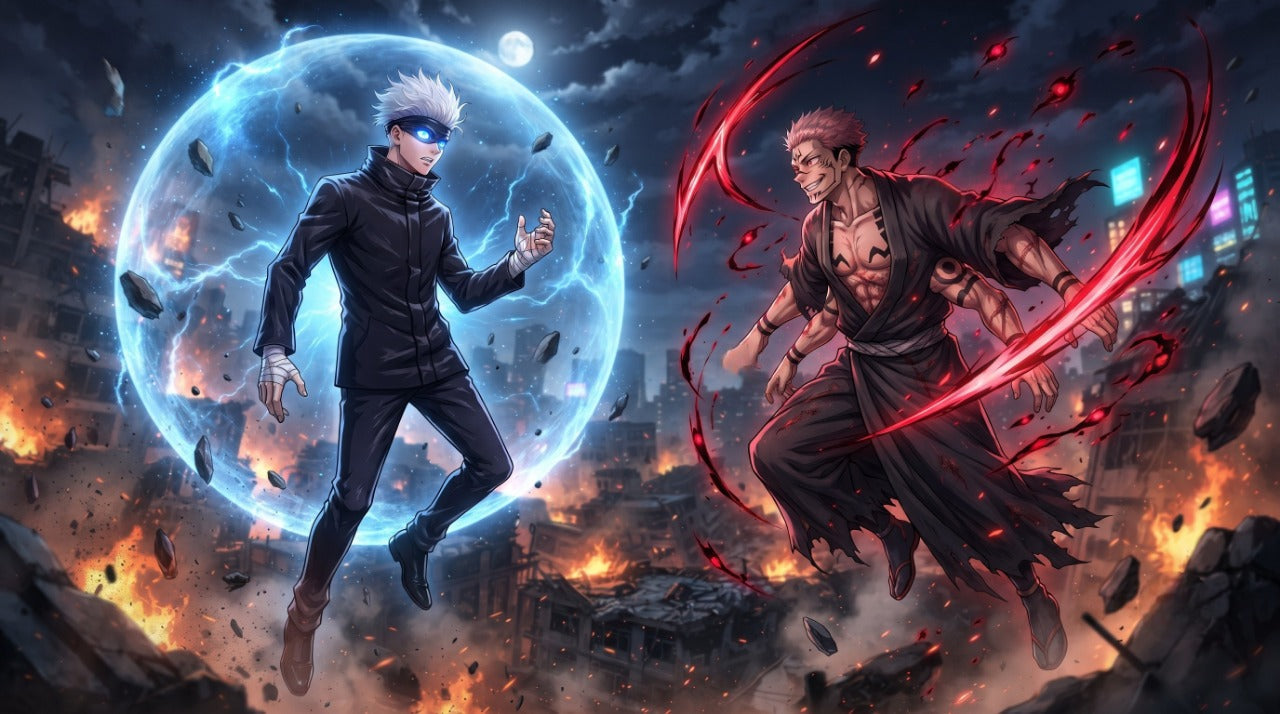
Update: July 2026 — the article covers the entire fight, chapters 221 to 236 of the manga.
For years, the question has raged in every schoolyard and every online thread: between Gojo Satoru, the strongest sorcerer of his era, and Ryomen Sukuna, the thousand-year-old King of Curses, who is truly the strongest? Since chapter 236 of Jujutsu Kaisen, the factual answer exists: Sukuna won their direct confrontation. But—and this is the whole point of the debate—he didn't win it by being stronger than Gojo in a pure exchange. He won it thanks to a trump card no one could counter: Mahoraga's adaptation. Here is the complete breakdown, the arguments from both sides, and our verdict.
The essentials in brief
- Winner of the fight: Sukuna, in chapter 236—this is a canonical fact, not an opinion.
- But: Gojo dominated the majority of the clash, notably winning the battle of domains four times.
- The turning point: Mahoraga's adaptation, which eventually "learned" to cleave Infinity itself.
- The debate remains open on the theoretical question: in a one-on-one duel, without summons and without Megumi's body, the outcome would likely have been the opposite.
- The author's position: Gege Akutami long presented Gojo as the absolute ceiling of power—that is precisely why it took a trick, and not brute force, to take him down.
Summary
- Where the debate comes from
- Before Shinjuku: why this fight almost never happened
- Gojo Satoru: the "strongest" arsenal
- Ryomen Sukuna: the King of Curses
- The Shinjuku fight, round by round
- The technical head-to-head
- Why the debate continues
- What this duel says about Jujutsu Kaisen
- Who wins between Gojo and Sukuna? Our verdict
- When will the Gojo vs Sukuna anime be, and where to read the fight
- Frequently asked questions
- To go further
Where the debate comes from
From volume 1, Jujutsu Kaisen establishes an unusual hierarchy: the strongest person in the world is not the hero, but his teacher. Gojo Satoru goes through the first arcs like an anomaly—untouchable, nonchalant, capable of neutralizing a special-grade curse while chatting. Opposite him, the series patiently builds his antithesis: Sukuna, a legendary curse from the Heian era, reduced to twenty cursed fingers, waiting for his moment in the body of Yuji Itadori.
The manga itself fueled the debate: from their very first meeting, Sukuna promised Gojo he would kill him. Gojo shrugged. This mutual assurance, sustained for over 200 chapters, made their confrontation one of the most anticipated fights in the history of modern shōnen. When it finally arrives—the Shinjuku arc, chapters 221 to 236—it lives up to its promises: it is a pinnacle of tactical writing, where every exchange is won on a technical detail. To understand it, one must first review the arsenal of both monsters.
Before Shinjuku: why this fight almost never happened
The irony of history: the most anticipated duel in the series was initially carefully avoided—by the villains themselves. When the Shibuya Incident breaks out, Kenjaku's plan at no point involves confronting Gojo: it involves putting him away. The Prison Realm, a cursed artifact capable of trapping anyone in a closed space outside of time, is deployed with pinpoint preparation. It will take an emotional decoy—the face of Geto, his dead friend—to immobilize Gojo for the few seconds required. The message was clear: even the curse camp, with an incomplete Sukuna in its ranks, considered that confronting Gojo head-on was not a plan, but suicide.
What followed were months of imprisonment during which the series demonstrated, through absence, what "the strongest" meant: without Gojo, the Japan of sorcerers collapsed piece by piece. His release, negotiated at a high price by his allies, led to an agreement of perfect shōnen simplicity: on December 24, in Shinjuku, Gojo would face Sukuna in a duel. No ambush, no plan B—a scheduled appointment. The series itself announced it as "the fight of the strongest of the era against the strongest in history." In the meantime, Sukuna changed vessels: he left Yuji Itadori's body for that of Megumi Fushiguro, a choice that, as we shall see, would decide everything.
Gojo Satoru: the "strongest" arsenal

Gojo's power rests on a genetic combination that hadn't occurred for several centuries within the Gojo clan: inheriting both the Infinity technique and the Six Eyes. Each of the two assets is formidable; together, they form an almost perfect system.
Infinity: the defense that cancels the very concept of a hit

Infinity is not a shield. It is a manipulation of space inspired by Achilles and the tortoise paradox: between the attacker and Gojo, there exist an infinite number of divisions of distance, and anything that approaches slows down asymptotically without ever touching him. A fist, a blade, a bullet—nothing makes contact. As long as Infinity is active, Gojo is literally untouchable, and he leaves it active permanently.
The series has shown only three ways to bypass it: a dedicated nullification technique (the Inverted Spear of Heaven wielded by Toji Fushiguro, destroyed long ago), manipulation of the soul, and... what Sukuna would eventually use. We will get to that.
The Six Eyes: the engine that makes everything free

Maintaining Infinity continuously should drain any cursed energy reserve. That is where the Six Eyes come in: this ocular mutation grants Gojo perfect perception of cursed energy—he "sees" techniques, flows, and intentions—and, above all, an energy yield so optimized that his consumption becomes negligible. Where an ordinary sorcerer exhausts themselves, Gojo runs in a constant state. It is this economy that allows him to chain the most costly techniques in the series as if they were warm-ups.
Blue, Red, Purple: the three-stage attack

Infinity is not just a wall: it is also a weapon. By playing with the convergence of space, Gojo creates Blue, a point of attraction that pulls everything toward it—debris, buildings, opponents. By reversing it, he produces Red, a repulsion wave twice as powerful. And by merging the two opposing charges, he obtains his trump card: Hollow Purple, a mass of condensed space that erases matter in its path rather than destroying it. In the Shinjuku fight, an amplified Purple leveled several city blocks—and took a part of the enemy domain with it.
This is the moment frozen by the Gojo Hollow Purple 35cm figure from our collection: the two fingers raised, the purple crescent wave—the weapon that nearly concluded the duel.
Unlimited Void: the domain that saturates the mind

Gojo's domain expansion, Unlimited Void, is perhaps the cruelest in the series: it inflicts no wounds. It dumps the totality of the information in the universe into the target's mind in an instant—to perceive everything is to perceive nothing at all. The victim remains standing, intact, mind saturated, incapable of the slightest movement. In Shibuya, half a second of exposure left civilians in physical therapy for months. In a domain duel, it is a death sentence... provided that the enemy domain breaks first.
Ryomen Sukuna: the King of Curses

Facing this perfect system, Sukuna aligns a radically different profile: no absolute defense, no miraculous engine—but a millennium of combat experience, unmatched tactical instinct, and techniques with a versatility Gojo lacks. Where Gojo is a system, Sukuna is a strategist.
Dismantle and Cleave: the most lethal default attack in the series

Sukuna's signature techniques are terrifyingly simple: Dismantle, an invisible blade that slices inanimate objects, and Cleave, its adjusted variation that cuts living beings according to their resistance. No visible incantation, no preparation, considerable range, and machine-gun speed. In Megumi's body, Sukuna adds an amplified variant—the "World-Cutting Slash"—capable, as its name suggests, of cutting things that should not be cuttable.
Our Sukuna Dismantle 23cm figure captures exactly this register: arm raised, scarlet arcs suspended in mid-air—the elegance of a killer who doesn't need to move.
Malevolent Shrine: a domain without walls

Sukuna's domain expansion, Malevolent Shrine, violates the basic rule of domains: it has no closed barrier. This demonic shrine under the open sky trades the protection of an enclosure for a massive radius of effect—up to about 200 meters—in which Cleave and Dismantle strike automatically and incessantly anything within it. It is a meat grinder on the scale of a neighborhood. And it is precisely this open structure, difficult to counter by classical means, that would make the difference in the battle of domains.
The rest of the arsenal: fire, lightning, and a stolen body
Reducing Sukuna to his blades would be a mistake that his opponents paid for dearly. His arsenal includes a fire technique—the incandescent arrow he only deployed in Shibuya, powerful enough to level entire neighborhoods, which our Sukuna Flames 30cm figure showcases—and, in Megumi's body, the Kamutoke artifact, a reserve of cursed lightning inherited from the Heian era. Add near-instant healing through reverse cursed energy, and you have a fighter who has no unfavorable setup: distance, melee, area-of-effect, one-on-one, one-on-a-hundred—he has a response for everything.
But his most Machiavellian move remains the choice of vessel. By taking over Megumi's body, Sukuna not only gains the Ten Shadows technique: he gains a psychological shield. Every blow Gojo lands, he lands on the body of his own student—the teenager he recruited, trained, and swore to protect. Sukuna even took care to break Megumi's soul before the duel, by making him live through the worst, to ensure no inner resistance would bother him. The King of Curses doesn't prepare for a fight: he poisons the very conditions of the fight.
The secret weapon: Megumi's Ten Shadows
A decisive detail that the Gojo camp rightly points out: in Shinjuku, Sukuna is not fighting in his original body. He occupies that of Megumi Fushiguro—and with it, his hereditary Ten Shadows technique, including the ultimate invocation: Mahoraga, the Eight-Handled Sword Divergent Sila Divine General. A shikigami that no member of the Zenin clan has ever tamed, and whose power can be summed up in one word: adaptation. Whatever phenomenon strikes it, its wheel turns, and it eventually becomes immune to it—then learns to slice through it.
The Shinjuku fight: the sequence, round by round
Let's summarize the confrontation as it actually unfolded in the manga:
- The Opening (ch. 223-224) — Physical exchanges of unimaginable violence. Gojo demands respect: even in melee, the "strongest" does not usurp his title.
- The War of Domains (ch. 224-227) — Four territory clashes. Gojo wins them all: his Unlimited Void crushes the Shrine at every barrier collision. Sukuna only survives by repairing his domain and playing for time.
- The entry of Mahoraga (ch. 229-230) — Cornered, Sukuna summons the Divine General, not to defeat Gojo... but to turn the wheel. While Gojo slices the shikigami, it accumulates data on Infinity.
- The devastating Purple (ch. 235) — Gojo levels the battlefield with an amplified Hollow Purple, amputates Mahoraga, and leaves Sukuna drained. Everything points to a victory for the sorcerer camp.
- The Turnaround (ch. 236) — The adaptation is complete: the "World-Cutting Slash," inherited from Mahoraga's analysis, cuts space itself—and therefore Infinity with it. Gojo falls, bisected, without having seen the blow coming.
-

The true duel was playing out there: every second of combat turned Mahoraga's wheel. One must measure the tactical perversity of the plan: Sukuna knew he would never break through Infinity by force. He therefore turned the fight into a learning session for his shikigami, accepting to lose every exchange, every domain, every round—to win the only one that mattered. A thousand years of experience summed up in one decision: do not try to beat Gojo's system, but force it to learn a counter-system.

Chapter 236: a single cut, and the end of an era. The supporting roles in a "one-on-one" duel
Officially, Shinjuku is a singular duel. In practice, the wings are swarming. On the cursed side, the spirit of Yorozu—an ancient rival from the Heian era reincarnated—serves as a dress rehearsal: by fighting her in Megumi's body, Sukuna tests the Ten Shadows and pushes Mahoraga to its limits before the big night, just to ensure he enters the duel already knowing the limits of his secret weapon. On the sorcerer side, an entire generation waits in the wings for the outcome of the fight: Yuta Okkotsu, designated as the potential successor to the title of "the strongest," Maki Zenin, and Yuji Itadori—the former vessel, the one who knows Sukuna from the inside.
This narrative device is no mere detail: it illuminates Sukuna's strategy. He isn't fighting just to defeat Gojo; he is fighting to defeat him while keeping enough reserves to face the queue waiting behind him. Every technique he saves, every round he "loses" without overcommitting, is part of the same chilling calculation. Gojo is playing a finale; Sukuna is playing a tournament.
Gojo vs. Sukuna: A Technical Face-Off
Gojo Satoru Ryomen Sukuna Defense Infinity (untouchable continuously) Durability, reverse cursed technique healing Attack Blue / Red / Hollow Purple Cleave / Dismantle / Flames Domain Unlimited Void (mental saturation) Malevolent Shrine (barrier-less, ~200m) Domain Clashes Won 4 / 4 0 / 4 Deciding Factor Six Eyes efficiency Mahoraga's adaptation + millennial experience Canonical Outcome Defeated (ch. 236) Winner Why the debate continues (and why both sides are right)
What the Gojo camp says
Gojo won the pure confrontation: four domain victories out of four, physical dominance, and a Sukuna reduced to desperate measures to survive. Above all, Sukuna did not win alone: without Megumi's body, there is no Ten Shadows; without Ten Shadows, there is no Mahoraga; without Mahoraga, there is no adaptation—and Infinity remains impenetrable. Let us also add the author's words, who has always described Gojo as the power ceiling of his universe: one literally had to invent a workaround to remove him from the narrative. In a "fair" duel, one-on-one, with the same starting arsenal, most readers—us included—see Gojo winning.
What the Sukuna camp says
Except that "fair" is a sorcerer's concept, not one held by the King of Curses. Using Megumi's stolen body, sacrificing Mahoraga as a learning probe, losing every round except the last: this isn't cheating, it is exactly what makes Sukuna the most dangerous—combat intelligence. Gojo's brute force was superior; Sukuna's strategy rendered it useless. And a fight, in Jujutsu Kaisen more than anywhere else, does not reward the most powerful: it rewards the one who imposes their conditions. The result is in chapter 236, and it is final.
What the author and community say
Gege Akutami has always been explicit: Gojo was designed as the power ceiling of the universe, a character so dominant that he posed a writing problem—the author has joked more than once about the difficulty of building a credible threat while he was at liberty. It is precisely this status that gives meaning to chapter 236: you don't dethrone a ceiling by jumping higher; you go around it. Side-lining Gojo through guile rather than a power creep is an authorial choice, consistent with a series that has always preferred tactics over last-minute power-ups.
As for the community, it remains split in two—and polls in both French and English confirm it: Sukuna generally wins by a short head for the title of "the strongest," carried by the canonical result, while Gojo retains a massive base arguing based on context. Tellingly, more than two years after the chapter's publication, the debate still generates just as many videos, threads, and tier lists. A defeat that fuels discussion more than any victory—perhaps that is the true hallmark of legendary characters.
Beyond the result: what this duel says about Jujutsu Kaisen
In most shōnen, a peak duel is resolved by a transformation: an extra level of power, unlocked at the best moment, which turns the tide—we have listed the most notable ones in our dossier on the best anime transformations. Jujutsu Kaisen takes the exact opposite approach: in Shinjuku, no one transforms. Both fighters arrive with known, announced, almost contractual rules—and the fight consists of exploiting the other's rules better than they exploit yours. It is a game of chess played at the speed of a kaiju battle.
This choice has a huge narrative cost, and Akutami paid it without flinching: the death of the series' most popular character, off-screen from his own perspective, at the peak of his glory. Many readers have not forgiven it; yet, that is what distinguishes the series. In Jujutsu Kaisen, power protects nothing, icons fall, and intelligence—in the coldest sense of the word—is the only stat that truly matters. The Gojo vs. Sukuna duel is not only the best fight in the series: it is its manifesto.
Who wins between Gojo and Sukuna? Our verdict
Sukuna wins. The winner of the duel has been established since chapter 236 of the manga: it is indeed he who kills Gojo, not the other way around. But the one who beat Gojo is not the most powerful of the two—and that is exactly where the debate begins.
The most powerful is Gojo. The strongest is Sukuna. The nuance is not a play on words: it is the heart of Gege Akutami's writing. Gojo possesses the best combat system ever shown in the series—but a system has rules, and rules can be learned. Sukuna, for his part, has no system: he has a thousand years of victories, a total lack of scruples, and the patience to learn the others'. The day the two faced off, intelligence beat perfection. It is cruel for Gojo fans—it is also, undoubtedly, the best ending for a debate that would have lost its flavor with an "obvious" winner.
Jujutsu Kaisen season 3 holds the top spot in our ranking of the best animes of 2026—we explain why there, and where to pick up the manga after episode 12.
To situate Jujutsu Kaisen among its peers, our ranking of the best combat animes places it on the podium.
Sources: Gege Akutami's manga and the official Jujutsu Kaisen anime website.
When will the Gojo vs. Sukuna anime air, and where to read the fight
The fight has not yet been animated. Season 3 of Jujutsu Kaisen, which adapts the Culling Game arc, aired from January 8 to March 26, 2026, on Crunchyroll in twelve episodes—and it stops before the duel. Gojo vs. Sukuna belongs to the Shinjuku arc, which will come next: no release date has been announced to date. To see it now, you must read it.
Medium Where the fight takes place Status Manga Chapters 221 to 236, Shinjuku Arc Available—the only way to see the duel today Anime — Season 3 Culling Game Arc, 12 episodes Finished: Jan 8 to March 26, 2026, Crunchyroll Anime — The Duel Shinjuku Arc, after Season 3 Not yet adapted, no date announced If you have just finished season 3 and want to continue without waiting, the duel takes place about eighty chapters after the stopping point of episode 12. Our ranking of the best animes of 2026 details exactly where to resume the manga, season by season.
Frequently Asked Questions
Who wins between Gojo and Sukuna?
Sukuna wins. He wins their direct confrontation in chapter 236, thanks to the "World-Cutting Dismantle" developed via Mahoraga's adaptation—an attack that slices through space and therefore ignores Infinity.
Did Gojo lose because he was weaker?
No. He dominated the majority of the fight and won all four domain clashes. He lost against a strategy designed specifically to bypass his defense, not against superior power.
Would Sukuna have won without Mahoraga and Megumi's body?
Nothing in the manga suggests it: without the shikigami's adaptation, none of his known techniques pierce Infinity. This is the central argument of the Gojo camp—and it is a solid one.
What exactly does Mahoraga's "adaptation" mean?
With every turn of its wheel, Mahoraga adjusts to a phenomenon that has struck it until it neutralizes it—then develops a way to cut through it. Faced with Infinity, it eventually "learned" to cut space itself, and Sukuna inherited that solution.
Is Gojo permanently dead in Jujutsu Kaisen?
His body is sliced in chapter 236, and the series accepts this loss as a narrative point of no return. We will not detail the following chapters here to protect anime viewers—but the fight against Sukuna itself is well and truly over.
When will the Gojo vs. Sukuna anime air?
The fight has not yet been animated. Season 3, dedicated to the Culling Game arc, ended on March 26, 2026, after twelve episodes and stops before the duel. Gojo vs. Sukuna belongs to the Shinjuku arc, which will be adapted later: no date has been announced to date. In the meantime, the fight can be read in chapters 221 to 236 of the manga.
Why didn't Gojo just maintain his domain continuously?
Unlimited Void also saturates... its user. Each extension has a huge concentration cost, and the barriers collide with those of the opponent: that is the whole stake of the "domain war" in chapters 224 to 227, which Gojo actually won four times.
What exactly is the "World-Cutting Dismantle"?
It is the culmination of Mahoraga's adaptation: a slash that no longer targets an object or a body, but space as such. Since Infinity is a manipulation of space, the slash travels "with" it—the defense is not pierced, it is included in what is being sliced.
Who killed Satoru Gojo?
Sukuna, in chapter 236. He did not win through brute force: he had Mahoraga adapt to Infinity, then sliced Gojo in two with the "World-Cutting Dismantle." It is a death achieved through learning, not power superiority—the nuance is at the heart of the debate.
Who beat Sukuna?
Yuji Itadori lands the final blow, but he does not win alone: Sukuna is defeated at the end of a collective confrontation involving, notably, Yuta Okkotsu, Higuruma Hiromi, Maki Zenin, and Todo Aoi, in the final chapters of the manga—the story ends in chapter 271. It is the exact opposite of the duel against Gojo: where the most powerful of sorcerers failed in a one-on-one, it is a group that finally brings down the King of Curses.
Who is stronger than Sukuna?
No one, one-on-one, at this point in the manga: Gojo was the only opponent capable of bringing him to his knees, and he fell. Sukuna is only defeated by a coalition—Yuji, Yuta, Maki, Todo, Higuruma, and the others—who wear him down fight after fight until chapter 268. This is the author's answer: the strongest is not beaten by someone stronger, but by sheer numbers.
To Go Further
Want to put the duel on display? Our Jujutsu Kaisen collection brings together both sides: Gojo Hollow Purple 35cm, Gojo Victor 33cm, and Gojo GK Premium on one side; Sukuna Dismantle 23cm, Sukuna Flames 30cm, and the unsettling Mahoraga on the other—not to mention Yuji Itadori, the vessel through whom it all happened.
Read next on the blog: the 16 best anime transformations of all time, and our guide to displaying and maintaining your figurines—large formats like the Hollow Purple 35cm have their own chapter there.