Ecchi is the most misunderstood genre of Japanese animation: neither innocent nor pornographic, it occupies a gray area where implication replaces the explicit and comedy serves as a lightning rod. This guide reviews the 15 best ecchi anime, from the genre's historical pillars to its wildest comedies, explaining what makes each of them worth watching — and for whom. You will also find the exact difference between ecchi, hentai, and fan service, three terms that are constantly confused.
Key Takeaways
- Ecchi ≠ hentai: ecchi suggests, hentai shows. An ecchi anime airs on Japanese television; a hentai does not.
- The word comes from the letter H, pronounced "etchi" in Japanese — an abbreviation of hentai co-opted as slang for "naughty."
- Three families: the unapologetic pillars (High School DxD, To Love-Ru), the comedies that push the boundaries (Prison School, Interspecies Reviewers), and series where ecchi is just an ingredient (Food Wars, Kill la Kill).
- The best entry point remains To Love-Ru for romantic comedy and High School DxD for action.
- The genre isn't dead: the Winter 2026 season still features several releases labeled as ecchi.
Table of Contents
- Ecchi, hentai, fan service: how to tell them apart
- The 15 best ecchi anime at a glance
- The five pillars of the genre
- Comedies that push the boundaries
- When ecchi is just an ingredient
- Where to start based on your profile
- The state of the genre in 2026
- From screen to shelf
- Frequently Asked Questions
Ecchi, hentai, fan service: how to tell them apart
These three words are used interchangeably even though they designate three different things. Untangling them takes thirty seconds and saves a lot of misunderstanding.

Ecchi (エッチ) comes from the Japanese pronunciation of the letter H, which is the first letter of hentai. The semantic shift is similar to the move between a colloquialism and a clinical description: it is a slang word, light, almost affectionate. An ecchi anime plays with suggestion — camera angles, misunderstandings, clothes falling off at the wrong time — but never shows a sexual act. It is broadcast on Japanese television during late-night slots, sometimes with an "uncensored" version reserved for home media.
Hentai (変態) literally means "pervert" or "abnormal" and, in the West, refers to explicit pornographic animation. It is not a more advanced variant of ecchi: it is a separate category with its own production and distribution channels.
Fan service is the broadest term of the three. It refers to anything an work includes to please its audience without narrative necessity — a beach episode, a bath scene, but also the return of a beloved character or a nod to a previous series. Fan service is therefore not necessarily sexual; ecchi is simply its naughty sub-genre.
In practice, the boundary is determined by a simple criterion: if the scene could air on broadcast television in Japan, it's ecchi. Otherwise, you’re in a different section.
The 15 best ecchi anime at a glance
| Anime | Year | Genre | Ecchi Intensity |
|---|---|---|---|
| High School DxD | 2012 | Action / Devils | High |
| To Love-Ru | 2008 | Romantic Comedy | High |
| Prison School | 2015 | Prison Comedy | Very High |
| Monster Musume | 2015 | Fantasy Harem | Very High |
| The Testament of Sister New Devil | 2015 | Action / Demons | Very High |
| Interspecies Reviewers | 2020 | Fantasy Comedy | Extreme |
| Shimoneta | 2015 | Political Satire | High |
| Keijo!!!!!!!! | 2016 | Absurdist Sports | High |
| Grand Blue | 2018 | College Comedy | Moderate |
| Golden Boy | 1995 | Comedy / Cult OVA | Moderate |
| Food Wars | 2015 | Cooking / Tournament | Moderate |
| Kill la Kill | 2013 | Stylized Action | Moderate |
| High School of the Dead | 2010 | Survival / Zombies | High |
| Fairy Tail | 2009 | Fantasy Shonen | Light |
| SoniAni: Super Sonico | 2014 | Slice of Life | Light |
The five pillars of the genre
These five series form the foundation: mentioning them is enough to place the genre for any fan of Japanese animation.

High School DxD (2012)

Issei Hyoudou dies in the first episode, killed on his first date by a girl who turns out to be a fallen angel. He is resurrected as a devil by Rias Gremory, heir to a great demonic house, and finds himself enrolled in a war between angels, devils, and deities. High School DxD has become the absolute benchmark for the genre for one precise reason: the series embraces its ecchi without ever sacrificing its plot. The battles are well-constructed, the mythology holds up, and the hero — whose declared ambition is to become "harem king" — eventually gains real depth. Four seasons, a coherent universe: it’s the ecchi that has aged the best.
To Love-Ru (2008)

Rito Yuuki, a high schooler with pathological shyness, finds Lala Deviluke, an alien princess on the run, in his bathtub, who immediately decides to marry him. Drawn by Kentaro Yabuki — also the author of Black Cat — the series built its success on an unstoppable mechanism: Rito never does anything deliberate; circumstances systematically send him to the wrong place at the wrong time. The sequel, To Love-Ru Darkness, pushes the boundaries much further and refocuses on Golden Darkness. The massive female cast has given the genre some of its most enduringly popular characters, starting with the class representative Kotegawa Yui, who spends the series screaming "it's indecent!" without ever managing to stay away.
Prison School (2015)

Five boys are admitted to a previously all-girls high school. Caught spying on the locker rooms, they are locked in the school's internal prison, run by an underground student council with methodical cruelty. Prison School is an anomaly: Akira Hiramoto's drawing is almost documentary-level realistic, the direction borrows from war films, and the whole thing is treated with absolute seriousness — which makes the result hilarious. It is probably the most intense series on this list, and paradoxically, one of the best-written.
Monster Musume (2015)
Japan has legalized interspecies exchange: mythological creatures now live among humans. Kimihito Kurusu inherits by mistake a lamia, then a harpy, a centaur, a slime... The series exploits every anatomy for gags that only a non-human creature allows, and fully embraces its status as a fantasy harem. Its real interest: remarkable design work on monster girls, which relaunched an entire sub-genre.
The Testament of Sister New Devil (2015)
Basara Tojo learns that his father is remarrying and that he is inheriting two stepsisters — who turn out to be the daughter of the demon king and her servant. A magical pact binds the three characters and tightens each time one of them resists the other: a script pretext of formidable efficiency. The series is known for its uncensored versions on physical media, which are significantly more explicit than the television broadcast.
Comedies that push the boundaries
Here, ecchi is no longer seasoning: it is the main comedic engine, often pushed to the point of the absurd.

Interspecies Reviewers (2020)
Three adventurers travel through the brothels of a fantasy world and rate their providers by species, with the rigor of a food critic. The concept, already, leaves no ambiguity. The series mainly went down in history for an external reason: it was pulled from several international platforms while airing, which gave it a notoriety that no marketing campaign could have bought. Reserve for a mature audience — it is by far the most explicit entry on this list.
Shimoneta (2015)
In a Japan where all obscene expression is punished by law and citizens wear collars that analyze their words, a terrorist organization spreads dirty jokes like others would plant bombs. Behind the crude concept, Shimoneta is a real satire of censorship and moral hygiene, carried by a masked heroine named Blue Snow. The ecchi genre rarely produces something this clever.
Keijo!!!!!!!! (2016)

Keijo is a fictional competitive sport where athletes face off on floating platforms and must knock their opponents into the water — without using their hands or feet. The series applies the entire grammar of sports shonen to this premise: training, secret techniques, rivals, national tournament. The disconnect between the seriousness of the treatment and the absurdity of the discipline is what gives the series its flavor.
Grand Blue (2018)
Iori Kitahara arrives at college with the idea of joining a diving club. He runs into a bunch of alcoholic and scantily clad students who almost never dive. Grand Blue is primarily a comedy about college life, and its ecchi is more masculine than feminine — which makes it an excellent entry point for anyone who wants to taste the genre without committing to a harem.
Golden Boy (1995)
Kintaro Oe left college one exam short of his degree, rides around Japan on a moped, and jumps from one odd job to another. In each episode, he learns a trade, meets a woman, and moves on having grown — without ever getting anything. This classic in six OVAs is thirty years old and remains one of the high points of comedic animation in the genre: the quality of the drawing and the timing of the expressions are superior to anything the genre has produced since.
When ecchi is just an ingredient
These series are not primarily classified as ecchi, but the genre has a visible enough place in them that they are systematically cited in discussions. They are often the best gateways.
Food Wars (2015)

Soma Yukihira joins an elite culinary school where every conflict is settled by a gastronomic duel. The series' peculiarity has become a global meme: tasting a successful dish triggers an ecstatic reaction in the characters that literally makes their clothes explode. Past this gimmick, Food Wars is an authentic tournament shonen, with real recipes and tension that builds season after season.
Kill la Kill (2013)

Ryuko Matoi arrives at a high school run with an iron fist, where power is measured by uniforms endowed with living fibers. The more revealing the uniform, the more powerful it makes the wearer: Studio Trigger thus transforms fan service into an explicit narrative mechanic, and the series eventually devotes an entire arc to the question of body shame. It is one of the rare cases where ecchi is the subject rather than the ornament.
High School of the Dead (2010)
An epidemic turns the population into the undead; a group of high schoolers tries to survive. Animated by Madhouse, the series is visually remarkable — slow motion, elaborate compositions — and has never hidden the fact that its fan service mattered as much as its zombies. It remains unfinished, as the death of its writer interrupted the manga.
Fairy Tail (2009)
The most famous mage guild in shonen is a light ecchi entry: Lucy Heartfilia regularly loses her clothes, Erza changes armor in the middle of battle, and bath scenes punctuate the arcs. Nothing more than a classic shonen generous with fan service, but it is often through here that readers discover the register.
SoniAni: Super Sonico (2014)
Super Sonico was not born from a manga: she is the mascot of the Japanese label Nitroplus, created in 2006 for a music festival. Her anime follows her in her daily life as a guitarist, student, and model — a quiet slice of life, where the fan service remains soft. The character has become one of the longest-running series of derivative figures on the Japanese market, which explains why you see her more often in shop windows than on screen.
Where to start based on your profile
| You are looking for… | Start with | Why |
|---|---|---|
| A real plot on top of the rest | High School DxD | Built mythology, serious fights, four seasons |
| Romantic comedy | To Love-Ru | Situational gags pushed to perfection |
| Loud laughter | Prison School | Ultra-serious treatment of a ridiculous premise |
| Testing the genre without diving in | Grand Blue or Food Wars | Ecchi is secondary, comedy comes first |
| Something intelligent | Shimoneta or Kill la Kill | Fan service is a real subject here, not an ornament |
| A classic to catch up on | Golden Boy | Six OVAs from 1995, still unmatched animation |
Where the genre stands in 2026

The death of ecchi is regularly announced, yet it returns every season. The reality is more nuanced: the genre has fragmented. On one hand, major general-audience productions have significantly reduced their fan service, deeming it incompatible with international distribution; on the other, specialized studios continue to adapt unapologetic manga, with more modest budgets but a loyal audience.
The Winter 2026 season still features several releases labeled as ecchi or harem, and 2025 saw the arrival of new adaptations in the genre. The most clear change concerns distribution: Western platforms have become cautious since the Interspecies Reviewers episode, and a portion of the genre is migrating to specialized services or physical media, which are the only ones to offer uncut versions.
Another development: the genre has spread beyond animation. Mobile games — Blue Archive, Nikke, Girls' Frontline — have adopted the aesthetic codes of ecchi and now fuel a considerable share of the figurine market, often without ever being adapted into an anime.
From the screen to the shelf

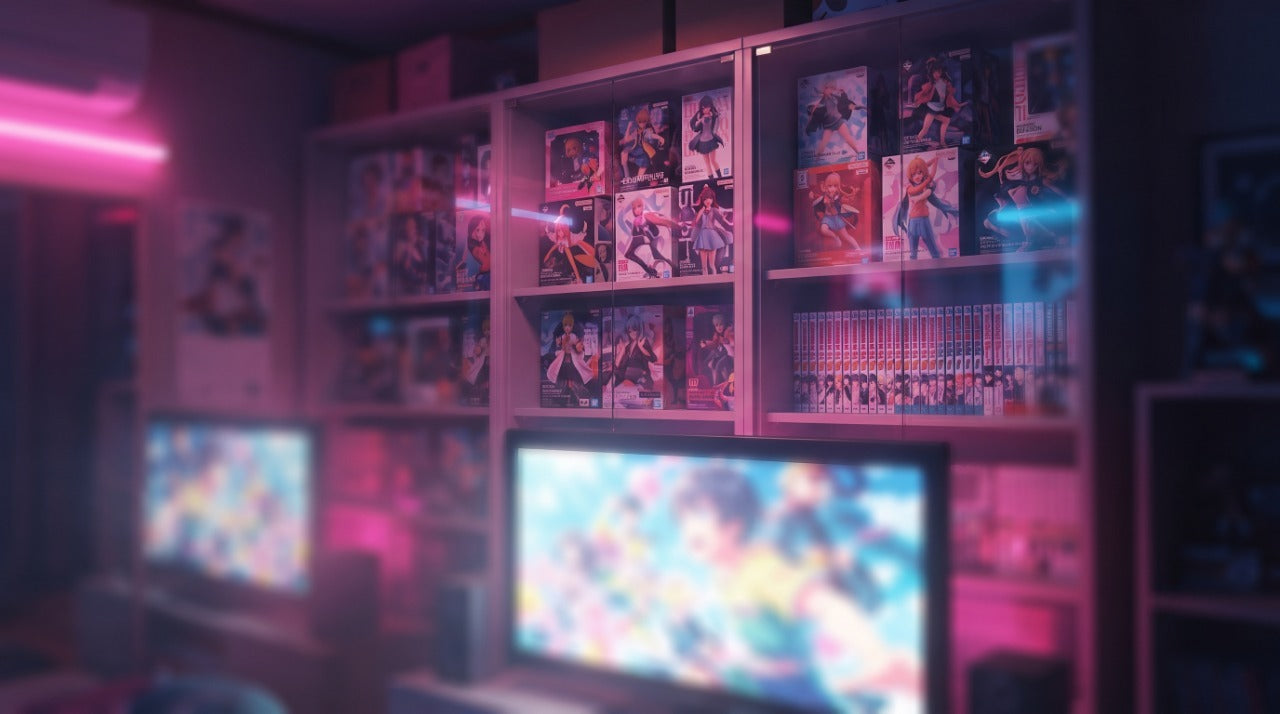
The genre has always maintained a direct link to collector's items. A standout character is released as a figurine in the months following their broadcast, and some heroines — Rias Gremory, Lala Deviluke, the girls from Monster Musume — have had more plastic iterations than episodes.
Two terms then come to mind: bishoujo (美少女, "beautiful young girl"), the name the industry gives to statues of female characters, and ecchi figurine or sexy figurine, the common designation among French-speaking collectors. Serious pieces in this segment can be recognized by three things: a stated scale (usually 1/7 or 1/6), a detailed base rather than a simple black disc, and paint that holds up under grazing light without looking plasticky.
We bring these pieces together in a dedicated display case: our collection of ecchi and bishoujo figurines, reserved for adult collectors. It notably features the class representative from To Love-Ru with the Kotegawa Yui qipao figurine, the Nitroplus mascot with the Super Sonico figurine, and the pilot of Unit 00 with the Rei Ayanami figurine.
One piece of advice before buying: these pieces require a bit more attention than others. Translucent materials yellow in the sun, complex poses collect dust, and large formats require a stable shelf. Our detailed recommendations are gathered in the guide Displaying and maintaining your manga figurines.
Frequently Asked Questions
What is the difference between ecchi and hentai?
Ecchi suggests, hentai shows. An ecchi anime plays with innuendo, camera angles, and awkward situations, but contains no explicit sexual acts: it is broadcast on Japanese television. Hentai, on the other hand, is pornographic animation, with its own production and distribution networks. These are not two levels of the same genre, but two distinct categories.
What does the word "ecchi" mean?
Ecchi (エッチ) is the Japanese pronunciation of the letter H, the first letter of the word hentai. Used as slang, it took on a much lighter meaning: "naughty," "mischievous." It is this softened word that eventually came to describe an entire register of Japanese animation.
What is the best ecchi anime to start with?
High School DxD if you want a real action plot in addition to fan service, To Love-Ru if you prefer romantic comedy. To test the genre without committing, Grand Blue and Food Wars are comedies where ecchi remains secondary.
Are ecchi anime censored in France?
They are not banned, but their distribution is restricted: most are rated for a mature audience, and some platforms have removed series during their broadcast — the most well-known case being Interspecies Reviewers in 2020. So-called "uncensored" versions are generally reserved for physical releases.
What is a bishoujo figurine?
Bishoujo (美少女) means "beautiful young girl" in Japanese. This is the term used by the figurine industry to refer to statues of female characters, generally at 1/7 or 1/6 scale. French-speaking collectors more commonly use the term sexy figurine or ecchi figurine for pieces in a clearly suggestive register.
Does the ecchi genre still exist in 2026?
Yes, but in a more fragmented form: major general-audience productions have reduced their fan service, while specialized studios continue to adapt unapologetic manga. The genre has also largely shifted toward mobile games — Blue Archive, Nikke, Girls' Frontline — which now fuel a large part of the figurine market.
What is an ecchi anime?
An anime that plays on erotic suggestion — outfits, situations, fan service — without ever showing explicit sexual acts: this is what separates it from hentai. The word comes from the letter H pronounced the Japanese way, an abbreviation of "hentai" in the sense of "naughty." Comedy, harem, sports, or action: ecchi is an ingredient more than a genre.
What are the 10 best ecchi anime?
In our ranking: High School DxD, To Love-Ru, Prison School, Monster Musume, The Testament of Sister New Devil, Interspecies Reviewers, Shimoneta, Keijo!!!!!!!!, Grand Blue, and Golden Boy. The next five — Food Wars, Kill la Kill, High School of the Dead, Fairy Tail, and Super Sonico — are detailed in the article.
What are the most ecchi anime?
Those that push suggestion the furthest without crossing into explicit territory: Interspecies Reviewers (removed from several platforms for this reason), Prison School, High School DxD, and To Love-Ru Darkness. At the other end of the spectrum, Food Wars or Kill la Kill use ecchi as a comedic device in mainstream series.
To learn more
- Our collection of ecchi and bishoujo figurines (adults only)
- The manga figurine collection, covering all universes
- The guide Displaying and maintaining your manga figurines
- Our ranking of the 16 best anime transformations
- The 1000-year history of manga, to place the genre in its context