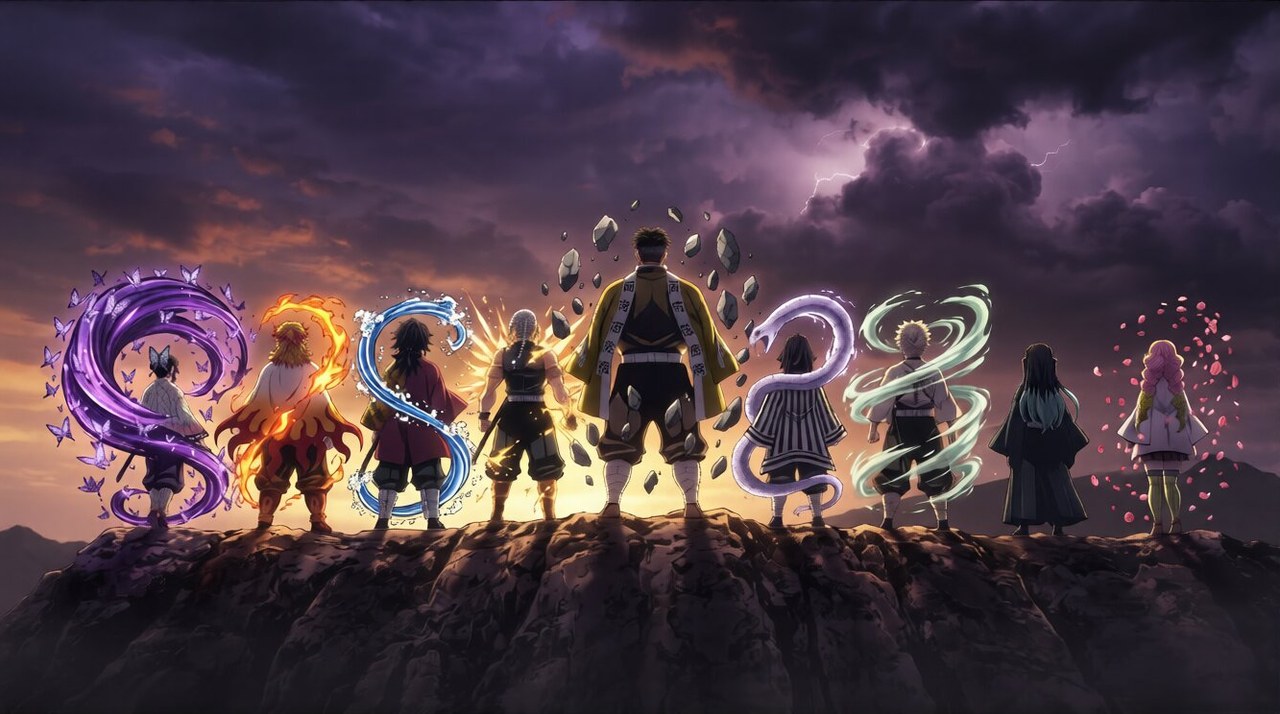
Who is truly the strongest of the 9 Demon Slayer Hashira? If you are looking for a short answer, here it is: the work itself designates Gyomei Himejima, the Stone Hashira, as the absolute pinnacle of the Demon Slayer Corps. But the real debate begins just below: who deserves second place? Why does the most famous of the Hashira not make the podium? And what is the most discreet among them really worth? Here is our complete ranking, from 9th to 1st, based solely on what the anime, films, and manga show in black and white — and written to not spoil anyone's fate: you can read it even if you have only watched the first season.
Updated August 28, 2026 — after the release of the first part of the Infinity Castle trilogy.
Key points at a glance
- The Hashira are the nine greatest swordsmen of the Demon Slayer Corps — the highest rank that exists.
- To become one, you must have reached the highest rank in the Corps, then defeat 50 demons... or just one of the Twelve Kizuki.
- Each embodies a Breathing Style: Water, Flame, Sound, Love, Serpent, Wind, Stone, Mist, and Insect.
- Our No. 1 is not an editorial choice: it is the one the characters themselves recognize as the strongest.
- The youngest is 14 years old, the oldest 27 years old — no Hashira is a graying veteran, and that is one of the silent tragedies of the series.
- Article guaranteed without major spoilers: the exploits mentioned stop at what the anime and the first film of the final trilogy have made public.
- Page updated with each release of the Infinity Castle trilogy — last check: August 2026.
Table of Contents
- 1. What is a Hashira?
- 2. Who are the 9 Hashira?
- 3. How we ranked them
- 4. The ranking, from 9th to 1st
- 5. The summary table
- 6. The three controversial debates
- 7. Frequently asked questions
- 8. To go further
What is a Hashira? The pinnacle of a shadow army

In the Taishō-era Japan where Demon Slayer takes place, the Demon Slayer Corps has been fighting in the shadows for centuries, without official existence. Its hierarchy has ten ranks — from the very young Mizunoto, the rank Tanjiro begins at, to the Kinoe rank. And above all this sit nine swordsmen who answer to no rank: the Hashira. The word is not just for show: they are literally the pillars supporting the entire structure. When one of them falls, the entire organization wavers.
You don't apply to be a Hashira; you rise to it. The conditions are brutally clear: reach Kinoe, the highest rank, then slay fifty demons... or just one of the Twelve Kizuki, the elites hand-picked by the demon master himself. The second path speaks volumes — the organization estimates that one Kizuki is worth fifty ordinary monsters, and history proves them right with every confrontation.
Finally, each Hashira embodies a Breathing style, those breathing techniques that multiply human capabilities. Five main strains — Water, Flame, Wind, Stone, Thunder — have, over generations, spawned more personal derivatives: Sound was born from Thunder, Love from Flame, Serpent from Water, Mist from Wind, and Insect from Flower. A Breathing style is never just a set of techniques: it is the mental portrait of the one practicing it. This ranking will demonstrate it nine times over.
To contextualize the work: Koyoharu Gotoge's series is detailed on the Demon Slayer Wikipedia page, and the Slayer Corps is described in the list of characters.
Who are the 9 Hashira of Demon Slayer?
They are called the Hashira or simply the "9 Hashira of Demon Slayer": they are the nine most powerful swordsmen in the Demon Slayer Corps, each a master of a breathing style.
Before the ranking, the identity cards. Here are the nine Hashira in active duty at the beginning of the story, presented in the order in which the narrative reveals them — with the breathing style each embodies and what makes them instantly recognizable.
| Hashira | Title | What distinguishes them |
|---|---|---|
| Giyu Tomioka | Water Hashira | The first encountered: the one who spares Nezuko and sends Tanjiro to Urokodaki. |
| Shinobu Kocho | Insect Hashira | Too frail to decapitate: she uses wisteria poison, unique in her field. |
| Kyojuro Rengoku | Flame Hashira | The hero of the Mugen Train, whose heart burns until his final breath. |
| Tengen Uzui | Sound Hashira | Former shinobi, two chained blades, an obsession with being "flamboyant." |
| Mitsuri Kanroji | Love Hashira | Extraordinary muscle density hidden behind disarming sweetness. |
| Muichiro Tokito | Mist Hashira | Became a Hashira at 14, in two months of training. |
| Obanai Iguro | Serpent Hashira | A wavy blade and Kaburamaru, the snake that never leaves his side. |
| Sanemi Shinazugawa | Wind Hashira | "Marechi" blood that intoxicates demons — a living weapon. |
| Gyomei Himejima | Stone Hashira | Blind, colossal, recognized by all as the strongest in the Corps. |
A point of vocabulary that often comes up: Gyomei's breathing is translated as Stone Hashira in most English versions. It is the same character and the same breathing style — the stone.
How we ranked them (and why you have the right to disagree)
Ranking the Hashira is a contact sport among fans, so let's set our rules. We base this on three criteria, in this order: verifiable combat feats (which opponent, under what conditions, with what result), physical and technical aptitudes shown on screen or in the pages, and finally internal recognition — what the characters say about each other, because the Demon Slayer Corps knows perfectly well who to fear. We use neither parody guidebooks nor popularity polls: charisma does not cut off a demon's head. The exercise has already sparked fireworks elsewhere — see our Gojo vs. Sukuna dossier and its readers at each other's throats.
One important detail: the exploits cited stop at what the anime (seasons 1 to 4), the film Mugen Train, and the first part of the Infinity Castle trilogy have made public. When the manga reserves a decisive role for a Hashira later on, we write about it without specifying which one — your 2027 evenings will thank us. Final warning: this ranking measures power, not human worth or utility within the Corps. 9th place is not an insult; at this level, even the "weakest link" slices up creatures that an entire battalion would not even slow down.
The ranking, from 9th to 1st
9. Shinobu Kocho — the Insect Hashira, death at the tip of a needle

Let's start with the hard truth: physically, Shinobu is the least powerful of the nine. She is the only Hashira unable to cut off a demon's head — the action that defines the profession. Frail and light, she cannot rely on the brute force of a Gyomei or the explosivity of a Sanemi. That is the case for the prosecution. Now, for the defense: Shinobu has turned this deadlock into a weapon that no other Hashira possesses. The first slayer in history to kill with poison, she designed toxins herself, derived from the wisteria that demons flee from, which she adjusts during the fight, opponent by opponent. Her needle-blade stings where others slice — and her thrusting speed is described as the most lightning-fast in the Corps.
Add a scientific brain: head of the Butterfly Mansion, she heals, dissects, and analyzes. Heir to her older sister Kanae, a former Flower Hashira — whose 31 cm Kanae Kocho figure reminds us of her elegance —, she always moves forward with a smile, and that perpetual smile might be the most chilling mask in the series. Ninth in pure strength, first in efficiency-to-weight ratio: that is the whole Shinobu paradox. Her flight amidst butterflies adorns both our 39 cm assault Shinobu figure and the Shinobu iPhone case — sweetness on the outside, poison on the inside.
8. Tengen Uzui — the Sound Hashira, the festival that strikes

A former ninja, husband to three kunoichi, and self-proclaimed devotee of "flamboyance": Tengen is a walking firework — and one of the most technically complete Hashira. His ninja past left him with an arsenal others lack: infiltration, poisons and anti-poisons, self-made bombs, and a way of reading combat through hearing that borders on echolocation. His Sound Breathing, derived from Thunder, converts this absolute hearing into a "score": he breaks down opponent movements into rhythms and spots the fatal false note. His two massive cleavers connected by a chain, which he twirls into walls of steel, require strength that his nearly two-meter frame provides without question.
His service record speaks for itself: in the Entertainment District, he faced an Upper Rank demon on the front line — a level above anything the series had shown until then — and won with the help of the recruits, at the cost of a hand and an eye. This shared victory and his early retirement deprive him of a higher spot: we are ranking complete trajectories, and his stopped in mid-ascent. What remains is the most dashing of the Hashira, the one whose Tengen fury iPhone case captures the unleashing, and whose chibi Sound Breathing version brings him to desk-height without losing any of the spectacle.
7. Kyojuro Rengoku — the Flame Hashira, the burning heart

Ranking him 7th will earn us some mail, so let's say it right away: at the moment he fought, Rengoku was arguably stronger than half of this ranking. Son of a former Flame Hashira, trained the hard way, he mastered the nine forms with a technical purity that his father never reached. In the Mugen Train, he faced Akaza, the Upper Rank Three — an opponent of a category that no one in the Corps had faced for decades — and held his ground, step by step, without retreating, until the end of the night. None of the two hundred passengers on the train lost their lives. It is one of the most famous acts of bravery in all of modern shōnen, and the outcome of this duel, which became manga legend as of 2020, forever defined what "dying as a Hashira" means.
So why 7th? Chronologically, cruelly: Rengoku fought before the era of the Demon Slayer Marks, those awakenings that would later multiply the capabilities of his peers. The Hashira at the top of this ranking had access to a level of power he never reached — not by limitation, but by calendar. On equal footing, the debate would be completely different, and we return to this in the debates section. His roar of flames inhabits our 30 cm Rengoku figure, and his LED lamp with sculpted flames does what no other licensed product does: it actually lights up the room, just like he did.
6. Obanai Iguro — the Serpent Hashira, the blade that ripples

Obanai is the Hashira the general public knows least — and the one purists defend most fiercely. Everything about him is a matter of precision: a sword with a wavy blade, unique in the Corps, whose serpentine strikes arrive from angles no guard anticipates; a Serpent Breathing style that favors unpredictable trajectory over frontal power; and Kaburamaru, the white snake coiled on his shoulders, whose sharp senses signal attacks he doesn't see coming. Small stature, immense standard: during the collective Hashira training, it is his sword-handling session that the recruits describe as the most merciless of all.
His feats of arms on screen remain, for now, less spectacular than those of his peers — the fault of a role that the story long kept in the background. That is precisely what makes his case interesting: the manga entrusts him, in the final arc, with a place that few readers saw coming, and about which we will say nothing other than this — it justifies by itself why no connoisseur ever ranks him last. Sixth in our list, with a margin for progression that the end of the cinema trilogy will make public. His tortuous guard coils on the Obanai and Kaburamaru case — giant snake assumed — and the Serpent Hashira chibi figure proves that one can be adorable with such a gaze.
5. Mitsuri Kanroji — the Love Hashira, the strength no one expects

Do not be fooled by the pink braids, the blushing, or the voracious appetite: Mitsuri is a biological phenomenon. Her muscle density is eight times greater than that of an ordinary human—a birth gift that long earned her mockery, until the Demon Slayer Corps saw it for what it is: an extraordinary striking force within a supple body. Her weapon belongs to her alone: an extremely flexible whip-sword, so thin and long it becomes a ribbon of steel, which only her unique musculature can control without injuring herself. Where others slash in straight lines, Mitsuri strikes in arabesques—volutes that cover an entire perimeter.
Trained by Rengoku, she invented her own Breath of Love, derived from Flame, as personal as her way of being. And when the Swordsmith Village was attacked, it was she who held her ground against a manifestation of an Upper Rank Moon, awakening her Slayer mark in the process—one of the very first to awaken in her generation, ahead of most of her seniors. A solid fifth place, earned fairly against our own prejudices. Her silhouette in the middle of an assault swirls on the Breath of Love iPhone case, and our 22cm Mitsuri figure in combat attire captures exactly that blend of grace and power that bewilders her opponents.
4. Giyu Tomioka — the Water Hashira, calm at the center of the torrent

The first Hashira to appear in the story—it is he who spares Nezuko and sends Tanjiro toward his destiny—Giyu is also the most misunderstood. Behind the closed face and counted words hides the purest technician among the swordsmen of his generation: his eleven forms of Water Breathing include an eleventh of his own invention, "Dead Calm," a state of absolute parry where enemy attacks die in a circle of still water. Creating an unprecedented form in the oldest and most taught Breath is to rewrite a page of a manual that is several centuries old.
His service record is impeccable: an Upper Rank demon cut down cleanly on Mt. Natagumo when the recruits were being wiped out, and, in the first part of The Infinity Castle, a tag-team duel with Tanjiro against Akaza—the same opponent as Rengoku—during which his Slayer mark awakened. The most striking thing about Giyu, however, lies elsewhere: this man who deemed himself unworthy of his title, haunted by those who fell for him, fights as if he must repay every minute of his survival. Doubt anchored in his sword, and yet a perfect sword nonetheless. His perfectly motionless dome of water inspires our 33cm Giyu figure, his Water Hashira case—and his water dragon even watches over in a chibi version.
3. Muichiro Tokito — the Mist Hashira, the 14-year-old genius

Muichiro is a statistical anomaly. Having become a Hashira two months after holding a sword for the first time—where the best take years—he is, at 14, the absolute youngest in the Corps, and is said to be descended from one of the most fearsome lineages of swordsmen the world has ever known. Long imprisoned by an amnesia that left him floating, head in the clouds, during meetings, he fights as his Mist Breathing suggests: by bypassing logic. His seven forms drown the opponent in a white curtain where every strike seems to come from everywhere at once—and his seventh form, of his own invention, turns this confusion into execution.
His great public work remains the Swordsmith Village: isolated, poisoned, trapped in a water prison, he defeated the fifth Upper Rank Moon alone—the first slayer in a century to take down an opponent of this rank without help. That day, his mark awakened, his memory returned, and the distracted boy revealed himself to be exactly what his name suggested: a prodigy with no known "limit." At 14 years old. One trembles to imagine what follows—the manga, however, knows it. His emergence from the mist floats on our 25cm Muichiro figure as it does on the Muichiro moonlight case, while his Mist Breathing chibi version reminds us that he remains, also, a child.
2. Sanemi Shinazugawa — the Wind Hashira, the storm with a human face

If Gyomei is quiet strength, Sanemi is simply strength—screaming, scarred, and never satiated. Every scar on his body tells the story of a demon who thought they had him. His Wind Breathing is the most offensive of the primary styles: blade-gusts that lacerate everything they touch, projected in assaults so furious they seem to precede thought. Add to that his most disturbing secret: Sanemi is a marechi, a carrier of blood so rare that its scent alone intoxicates demons to the point of dizziness. His own body is a trap—bleeding, for him, is a tactic.
His reputation within the Corps suffers no ambiguity: when the Hashira speak of their best swordsmen, his name comes right after Gyomei's, and their sparring sessions during collective training—a spectacle the recruits watched as one watches a typhoon—sealed the hierarchy. Behind the rage, the story of the older brother who sacrificed everything can be guessed in every excess; the series has since confirmed it, and it retroactively transforms every one of his screams. In the final arc, the manga reserves for him one of the most dizzying duels of the entire work—that is all we will say. His charge into the storm tears through our Sanemi Shinazugawa case, and even his Wind Breathing chibi figure keeps the smile of battle—the one that bodes nothing good.
1. Gyomei Himejima — the Stone Hashira, the summit recognized by all

There is no debate, and that is what makes the Gyomei case fascinating: the strongest of the Hashira is designated as such within the work itself—by his peers, by his oldest enemies, and by Tanjiro who observes him with expert eyes. Blind, over two meters tall, a silhouette of a walking temple: Gyomei does not even use a sword. His weapon, unique in the history of the Corps, is a spiked flail connected by a chain to a massive axe—two masses of demon-slaying steel that he spins solely by reading the sounds of the battlefield, with a precision that eyes would not provide. His Stone Breathing, the hardest of the five primary strains, converts this mass into strikes that literally pulverize the ground.
The man surpasses the fighter. Before being a slayer, this gentle colossus who cries constantly—out of compassion, not fear—protected orphans; on a night of horror against a demon, he held out until dawn with his bare hands, without training, without breath, without a weapon. The Demon Slayer Corps understood what they had: he attained the rank of Hashira in record time. Since then, he has been the silent big brother of the organization, the one to whom the other eight turn when everything wavers. Brute force, combat sense, wisdom: the summit, on all three pillars at once. His prayer under the moon watches over our Gyomei, Stone Hashira figure and the Gyomei in prayer case—and yes, the tearful colossus also exists as a lucky cat, prayer beads included.
Summary table
| Rank | Hashira | Breath | Signature | Where to see him shine |
|---|---|---|---|---|
| 1 | Gyomei Himejima | Stone | Flail and axe connected by a chain, blindness compensated by hearing | Season 4, then the final trilogy |
| 2 | Sanemi Shinazugawa | Wind | Marechi blood that intoxicates demons | Seasons 1 and 4, then the final trilogy |
| 3 | Muichiro Tokito | Mist | Hashira at 14, in two months of training | Season 3 (Swordsmith Village) |
| 4 | Giyu Tomioka | Water | 11th form "Dead Calm," of his own invention | Season 1, film The Infinity Castle Part 1 |
| 5 | Mitsuri Kanroji | Love | Muscle density ×8, whip-sword | Season 3 (Swordsmith Village) |
| 6 | Obanai Iguro | Serpent | Wavy blade, the serpent Kaburamaru | Season 4, then the final trilogy |
| 7 | Kyojuro Rengoku | Flame | Alone against Akaza, 200 passengers saved | Film Mugen Train |
| 8 | Tengen Uzui | Sound | Ex-shinobi, two chained cleavers, three ninja wives | Season 2 (Entertainment District) |
| 9 | Shinobu Kocho | Insect | Wisteria poison, fastest thrust in the Corps | Seasons 1-2, then the final trilogy |
The three contentious debates
"Rengoku at 7th is a scandal." This is the criticism we will receive the most, and it is legitimate. Let us remember our criteria: complete trajectories, with the power levels actually achieved. Rengoku never had access to the era of the marks, which reshuffled the deck after him. But let us ask the forbidden question: a marked Rengoku, with ten more years? Most readers would place him on the podium, and we would not contradict them. His 7th rank measures a cut-short destiny, not a ceiling. This chronological vertigo is not unique to the Hashira: our top 10 Bleach bankai faces the same problem of eras.
"Shinobu last, when she kills what others cannot touch." Also true. Poison bypasses the duel where strength wins it: against certain opponents, Shinobu's arsenal is the only one that works. But a power ranking measures the ability to impose oneself in all configurations, and her dependence on preparation makes her more situational than her peers. Ninth in arm wrestling, in a class of her own for ingenuity—both are true at the same time.
"Giyu above or below Sanemi?" The only really debatable gap in our expanded podium. Giyu has the cleanest on-screen feats; Sanemi has the internal reputation, the aggression, and a biological asset that nothing neutralizes. We decided based on the recognition of the Corps itself, which always cites Sanemi just behind Gyomei. If your heart flips the two, it has good arguments—it is exactly the kind of debate that our One Piece tier list has already brought to life for another franchise, and which the greatest anime transformations gladly prolong.
Sources: the manga by Koyoharu Gotōge and the official Demon Slayer anime portal.
Each Hashira carries a Nichirin blade with a color unique to them. We offer 1:1 scale replicas in our collection of Demon Slayer katanas—from Rengoku's red sword to the wavy blade of Obanai.
Frequently Asked Questions
Who is the Earth Hashira in Demon Slayer?
That is Gyomei Himejima. His Breath is that of Stone: depending on the translation, he is referred to as the Stone Hashira, the Earth Hashira, or the Rock Hashira—three names for one and the same character. Blind, armed with a flail and an axe connected by a chain, he is considered within the work to be the most powerful of the nine.
Who is the strongest Hashira in Demon Slayer?
Gyomei Himejima, the Stone Hashira. This is not a fan opinion: the work explicitly designates him as such, through the voices of his peers and his enemies alike. Blind, armed with a flail and an axe connected by a chain, he dominates the Corps in both brute force and combat clarity.
Who is the weakest Hashira?
In pure physical strength, Shinobu Kocho—the only Hashira incapable of decapitating a demon. But her wisteria poison, which she adjusts in the middle of battle, allows her to take down opponents that a blade alone could not defeat: "the weakest" remains one of the most effective slayers in the Corps.
How many Hashira are there in Demon Slayer?
There are nine active Hashira at the beginning of the story: Water, Flame, Sound, Love, Serpent, Wind, Stone, Mist, and Insect. Former Hashira also exist, such as Kanae Kocho (Flower), who fell against a demon before the beginning of the story, or Rengoku's father (Flame), who surrendered his title.
How does one become a Hashira?
One must first climb the ten ranks of the Slayer Corps to the Kinoe rank, then defeat fifty demons—or a single one of the Twelve Kizuki. A Hashira seat only becomes vacant through death, retirement, or the promotion of a trained successor.
How old are the Hashira?
From 14 years old for Muichiro Tokito, the prodigy youngest, to 27 years old for Gyomei Himejima, the eldest. Most are between 18 and 23 years old—a youth that says a lot about the life expectancy of the profession.
Why isn't Rengoku ranked higher?
Because he fought before the era of the Slayer marks, which subsequently allowed several of his peers to reach a new level. Under equal conditions, his solo duel against Akaza in the Mugen Train would place him much higher—our ranking measures actual trajectories, not hypotheses.
In which anime arcs does each Hashira shine?
Giyu and Shinobu from Season 1, Rengoku in the film Mugen Train, Tengen in Season 2, Mitsuri and Muichiro in Season 3, and all nine in Season 4 devoted to their training—before the final trilogy, The Infinity Castle.
Does the film *The Infinity Castle* feature all the Hashira?
The trilogy adapts the final arc: all nine Hashira are involved. The first part focuses particularly on Shinobu and Giyu; parts 2 and 3 do not yet have an official date—part 2 is expected no earlier than 2027. This page will be updated with each announcement.
Who are the 9 Hashira in Demon Slayer?
Giyu Tomioka (Water), Kyojuro Rengoku (Flame), Tengen Uzui (Sound), Mitsuri Kanroji (Love), Obanai Iguro (Serpent), Sanemi Shinazugawa (Wind), Gyomei Himejima (Stone), Muichiro Tokito (Mist), and Shinobu Kocho (Insect). Each has their own profile and rank in the ranking above.
Are there 12 Hashira in Demon Slayer?
No: nine. The confusion comes from the Twelve Kizuki, the circle of elite demons serving Muzan—six Upper Moons and six Lower Moons. The Hashira are their designated adversaries: killing a Moon is one of the ways to become a Hashira.
In summary
Gyomei reigns supreme, Sanemi growls right behind him, Muichiro is the unstoppable future, and every rank in this list defends itself, weapon in hand—that is the great success of this gallery of characters: nine styles, nine wounds, nine reasons to fight, and not a single filler character. The Infinity Castle trilogy will reshuffle the cards for the general public by 2027; we will update this ranking with each release, without ever spoiling the next one. Until then, you now know who to fear—and who underestimating would be the last mistake of your demon life.
To go further
And if you want to take them with you: our set of nine Hashira keychains captures the gaze of each one in an acrylic block—all nine, not eight.
The nine guardians are waiting for you in our shop: our Demon Slayer figures feature the Hashira from display-case size to large format, our Demon Slayer iPhone cases showcase their breathing styles in about thirty designs, and the chibi versions—lucky cats included—prove that even Sanemi can be cute without losing his honor. To ensure your squad stands the test of time, our guide on how to display and maintain your anime figures completes the tour.
And if this ranking is to help you give a gift of a figure or sword to a Demon Slayer fan, our guide to manga gifts, by person and by budget tells you which one to choose according to their age and status.